Originally the Austro-Hungarian torpedo boat 76T, the vessel later served as T1 and Golešnica 91. Its changing names reflect the political history of the Adriatic. After a long service life it was sunk as a naval exercise target in 1959. The surviving bow, collapsed central section and propeller shaft supports remain part of the archaeological record.
Torpedo boat / Near Žanjice
Golešnica 91
One vessel, several names, and a life spanning two world wars.
Original photogrammetry4.7 MB · interactive 3D · 3 points of interest
Explore Golešnica 91.
The real site, captured in three dimensions.
Points of interest
Select a point to fly to it on the scan and read what divers find there.
From the collection
Closer to the evidence.
The research narrative
A deeper reading.
Torpedo Boat 76 T / Golešnica
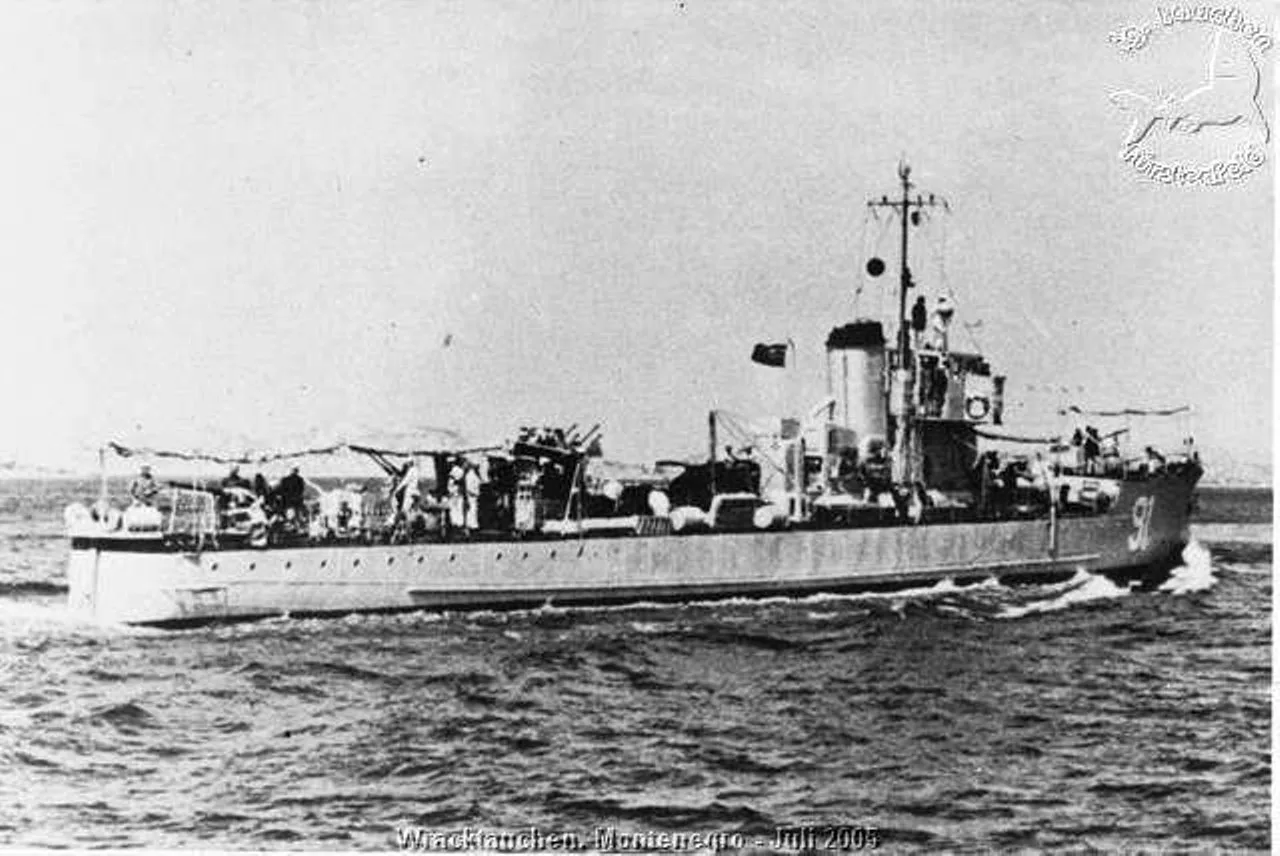
Resting on a sandy seabed near Žanjice, at a depth of approximately 35 metres, the wreck of 76 T preserves an extraordinary naval history spanning two world wars, three navies and several different names. Built for Austria-Hungary shortly before the First World War, it later served as the Yugoslav T1, the Italian T1 and, finally, the patrol vessel Golešnica.
Built for speed
76 T belonged to the T-group of the Austro-Hungarian Navy’s 250-ton class of seagoing torpedo boats. Eight vessels of this group—numbered 74 T to 81 T—were built by Stabilimento Tecnico Triestino at its San Marco shipyard in Trieste.
The boat was launched on 15 December 1913 and entered Austro-Hungarian naval service on 20 July 1914, only days before the outbreak of the First World War. The letter “T” indicated the shipyard at Trieste; in May 1917, the letter suffixes were removed from Austro-Hungarian torpedo-boat designations, after which the vessel was officially known simply as 76.
The vessel measured approximately 57.8 metres in length and 5.75 metres across the beam, with a normal displacement of about 262 tonnes. Two oil-fired Yarrow boilers supplied steam to Parsons turbines driving two propeller shafts.
The design requirement called for a vessel capable of maintaining 30 knots for ten hours—sufficient to cross the Strait of Otranto, attack an enemy force and return to the Austro-Hungarian base at Cattaro, present-day Kotor. In service, the class achieved a maximum speed of approximately 28 knots.
Torpedoes and mines
The principal weapons of 76 T were four 450-millimetre torpedo tubes, supported by two 66-millimetre Škoda guns and, later, a machine gun. It could also carry approximately 10–12 naval mines.
Torpedo boats were intended to use their speed and small size to approach larger enemy warships, launch torpedoes and withdraw quickly. The Austro-Hungarian Navy also employed them for reconnaissance, convoy escort, anti-submarine patrols, minesweeping, minelaying and the bombardment of coastal targets.
The original tactical concept placed groups of torpedo boats behind a formation of battleships. If enemy capital ships were damaged or isolated, the smaller vessels would move forward in coordinated groups and attempt a torpedo attack.
The Adriatic campaign
After entering service, 76 T joined the 1st Torpedo Group of the Austro-Hungarian 1st Torpedo Flotilla. During the First World War, it operated throughout the Adriatic, initially from northern bases and later from the Bay of Kotor.
The vessel carried out patrol, escort, convoy and anti-submarine duties. It also supported reconnaissance and offensive missions toward the Italian coast and the strategically important islands and sea lanes of the central and southern Adriatic.
In July 1915, 76 T joined the cruisers Admiral Spaun and Novara, other torpedo boats and destroyers in an operation against the Italian Adriatic coast. The force shelled railway infrastructure between Ancona and Pesaro, including targets near Fano, while Austro-Hungarian aircraft attacked Ancona.
The frequently repeated statement that 76 T participated in the principal bombardment of Ancona immediately after Italy entered the war in May 1915 is not supported by the detailed operational summaries located for this review. Its documented action in the area took place on 27 July 1915.
Based in Kotor
In late 1915, six T-group torpedo boats were transferred from Pola, present-day Pula, to the Bay of Kotor. Their mission was to patrol the Albanian coast, escort supply traffic and intercept Allied vessels transporting personnel and equipment across the Adriatic.
By early 1917, 76 was operating from the Bay of Kotor as part of a force that included the scout cruiser Helgoland, Tátra-class destroyers and other 250-ton torpedo boats. Its duties included convoy protection, submarine searches, minelaying and support for operations against the Otranto Barrage.
The Otranto Barrage was an Allied attempt to restrict the movement of Austro-Hungarian and German submarines between the Adriatic and the wider Mediterranean. Although it never completely sealed the strait, it became a central focus of Austro-Hungarian naval operations.
Escorting Szent István
In June 1918, 76 participated in Austria-Hungary’s final attempt to launch a major fleet operation in the Adriatic. The plan called for battleships, cruisers, destroyers and torpedo boats to attack the Allied forces maintaining the Otranto Barrage.
During the operation, 76 formed part of the escort for the dreadnought SMS Szent István. In the early hours of 10 June, the Italian motor torpedo boats MAS 15 and MAS 21 penetrated the escort screen near the island of Premuda. MAS 15, commanded by Luigi Rizzo, fired two torpedoes that struck Szent István.
The battleship capsized and sank less than three hours later. Its loss led to the cancellation of the operation and effectively ended large-scale Austro-Hungarian fleet activity during the remaining months of the war.
76 continued performing support duties. In July 1918, it helped tow the damaged submarine SM U-10 to Trieste, and in October it returned to the Bay of Kotor.
From 76 T to T1
After the collapse of Austria-Hungary, the vessel was allocated to the newly established Kingdom of Serbs, Croats and Slovenes under the post-war settlement. It entered the new state’s navy as T1, together with several other former Austro-Hungarian torpedo boats.
These vessels were particularly important because the new navy possessed relatively few modern seagoing warships. During the interwar period, however, limited funding restricted their operation largely to training, patrols and fleet exercises.
By April 1941, T1 was assigned to the Royal Yugoslav Navy’s Southern Sector Command at Kotor. Although old by then, it remained an operational torpedo boat when the Axis powers invaded Yugoslavia.
Under the Italian flag
Following Yugoslavia’s capitulation in April 1941, the Italian Royal Navy captured T1 and retained its Yugoslav designation. The Italians modernized its armament, replacing its original guns with two 76-millimetre anti-aircraft guns and enclosing the bridge.
The vessel subsequently performed coastal patrol and secondary escort duties in the Adriatic. It was used to protect shipping and support Italian operations along the occupied Yugoslav coast rather than serving primarily as a combat vessel against Partisan units.
On 21 January 1943, T1 was escorting the steamship Cassala near Cape Mendra, south of Ulcinj, when the British submarine HMS Tigris attacked. Four torpedoes were fired, but all missed, allowing both vessels to escape.
Return to Yugoslav service
After Italy announced its armistice with the Allies in September 1943, T1 avoided capture by German forces. It sailed from the Bay of Kotor with other vessels and eventually reached Allied-controlled waters.
The boat was formally returned to the Royal Yugoslav Navy-in-exile at Malta in December 1943. This corrects accounts claiming that it remained under Italian or German control until the end of the war.
In August 1945, the vessel passed into the navy of the new Yugoslav state. It was subsequently refitted, rearmed and renamed Golešnica, after a mountain in present-day North Macedonia.
Patrol vessel Golešnica
In post-war Yugoslav service, the former torpedo boat was initially classified as a guard ship with the designation ŠBR-91. It was later reclassified as patrol vessel PBR-91.
Its armament was extensively modernized. It reportedly carried two single 40-millimetre Bofors guns, 20-millimetre anti-aircraft weapons, one remaining pair of torpedo tubes and equipment for deploying depth charges.
The vessel served mainly on coastal and border patrols and was also used for naval training. Its age and worn machinery reduced its maximum speed to about 22 knots, significantly below the performance achieved during its Austro-Hungarian service.
Golešnica was withdrawn from active service in 1955. It remained on the naval register until 1959, when the ageing and disarmed vessel was selected for use as a target.
The final exercise
In 1959, Golešnica was sunk during a Yugoslav naval exercise in Žanjice Bay, near the western entrance to the Bay of Kotor. Unlike many of Montenegro’s wartime wrecks, it was therefore not lost in battle or through a maritime accident.
Its deliberate sinking marked the end of an operational life lasting more than four decades. The same hull had served the Austro-Hungarian Navy, the Royal Yugoslav Navy, the Italian Royal Navy, the Yugoslav Navy-in-exile and the post-war Yugoslav Navy.
This complex history makes 76 T an exceptional example of how warships could outlive the empires and states that created them, passing repeatedly between opposing navies as political borders changed.
The wreck today
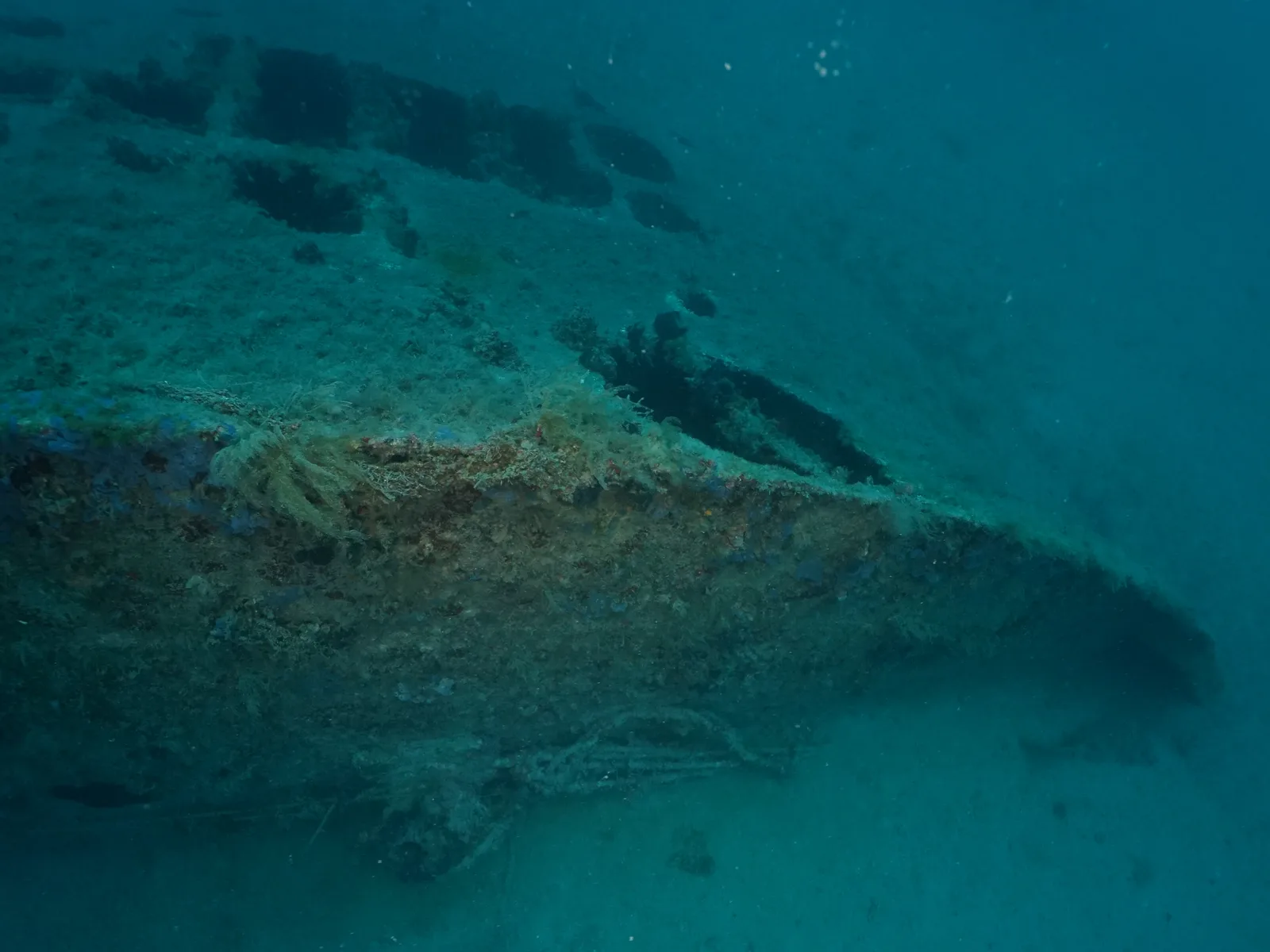
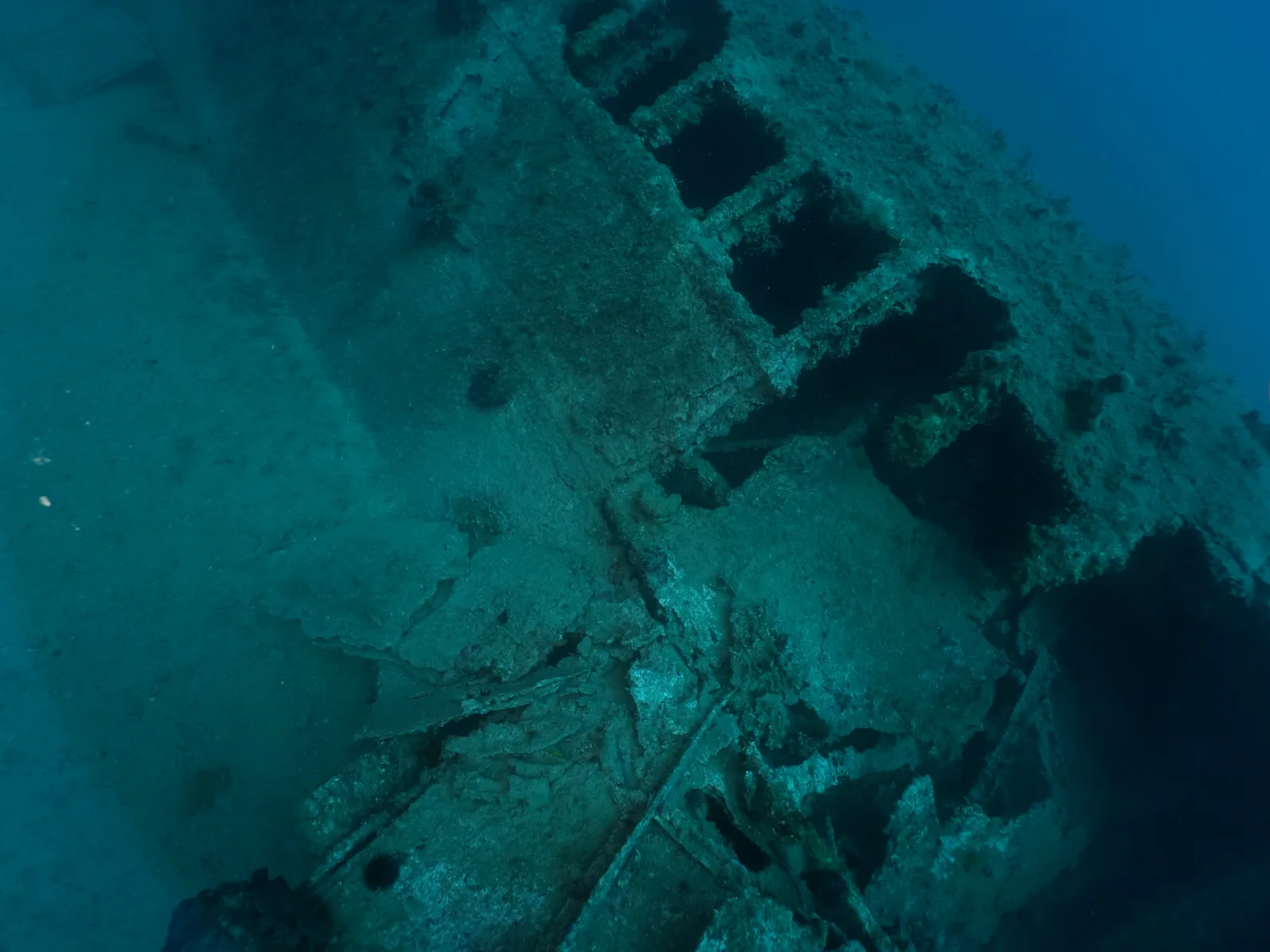
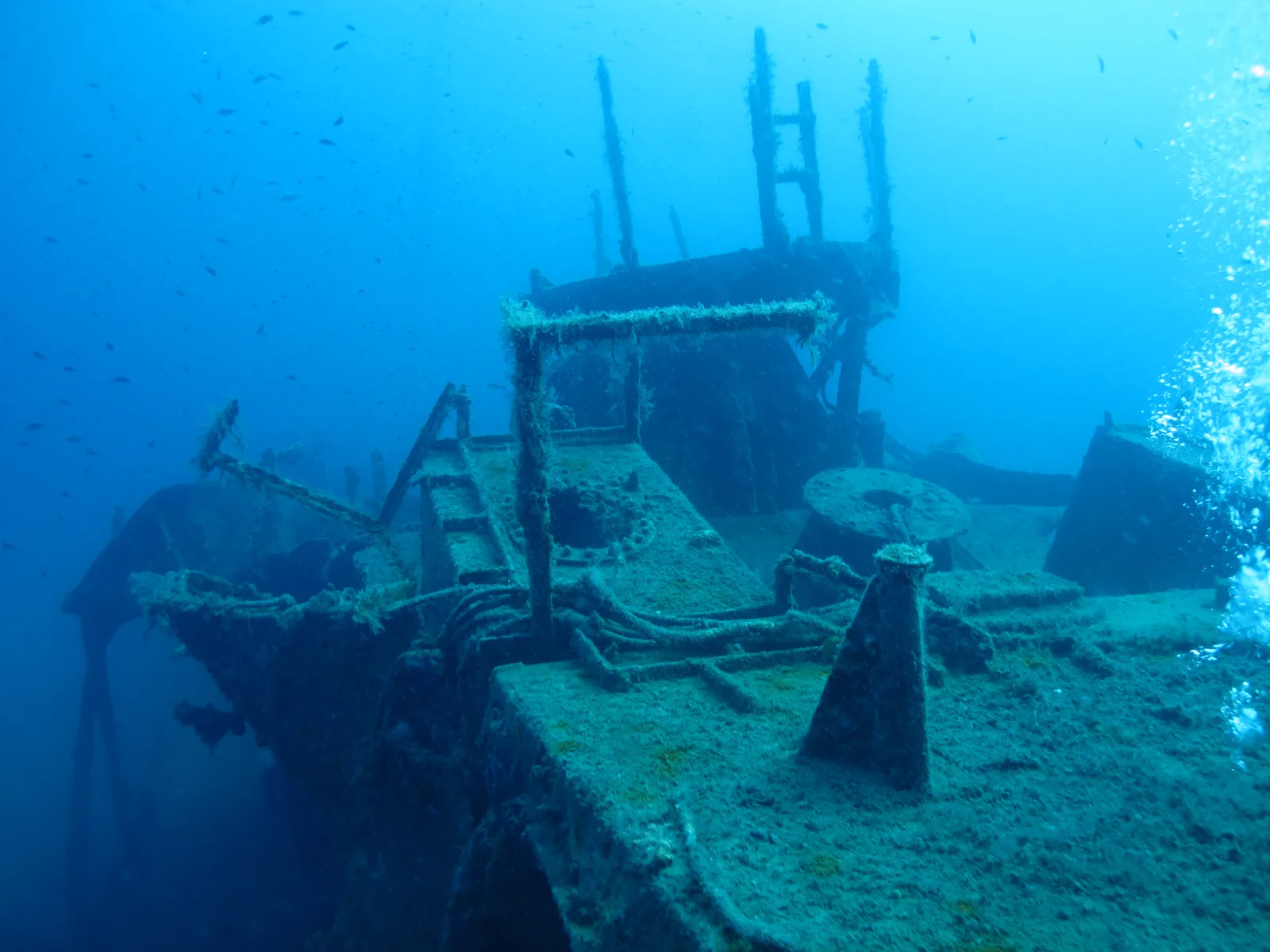
The wreck rests on a sandy seabed near Žanjice at a depth generally reported between 33 and 35 metres. Its approximately 58-metre-long structure remains recognizable, although the hull has deteriorated considerably since the vessel was sunk.
Published descriptions disagree over its precise orientation. Some report that the vessel lies mainly on its port side, while others describe the bow as turned onto the starboard side and partly embedded in the sand. This difference may reflect the collapse and twisting of separate hull sections, but a comprehensive archaeological survey is needed to record the present position accurately.
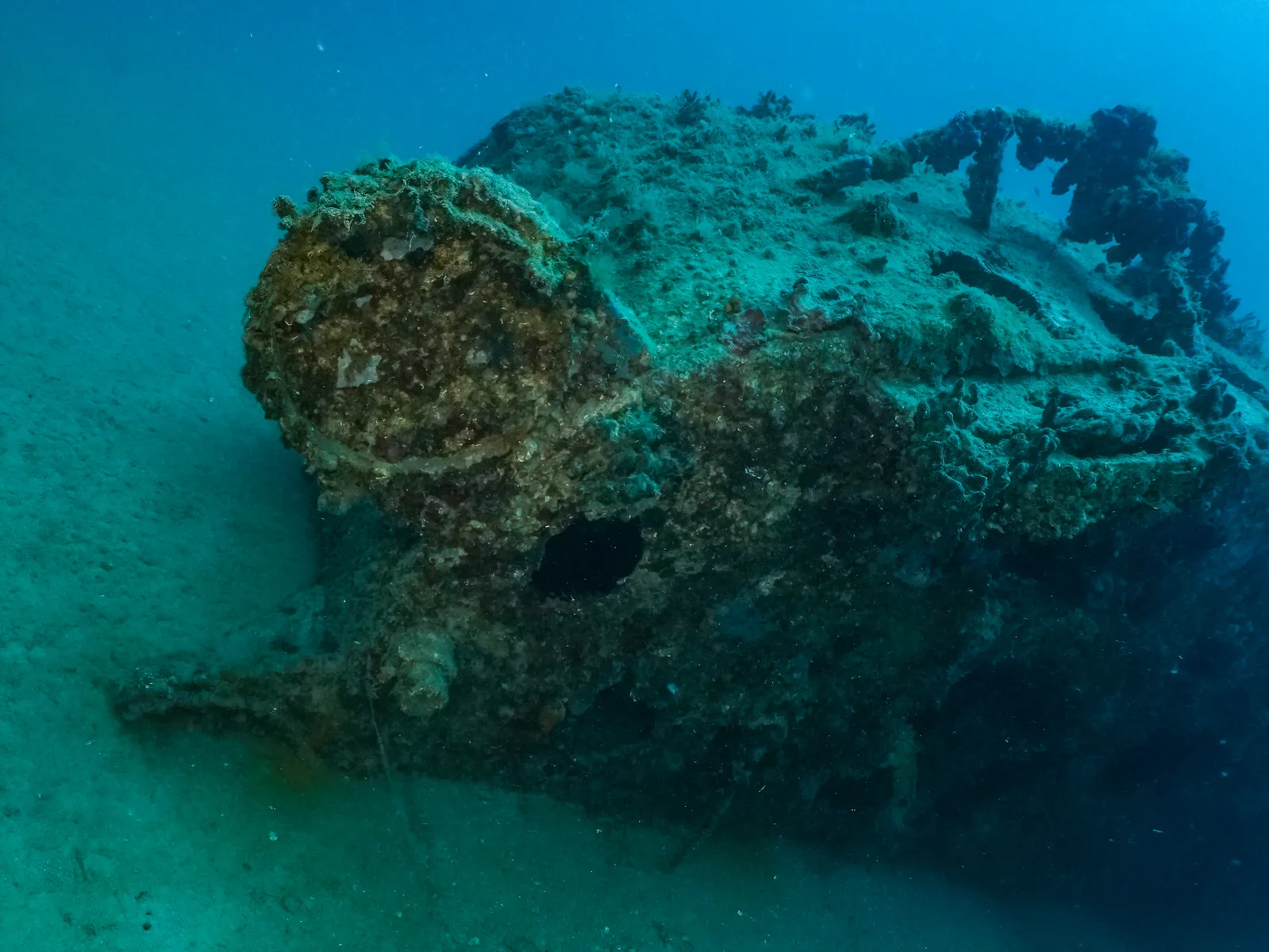
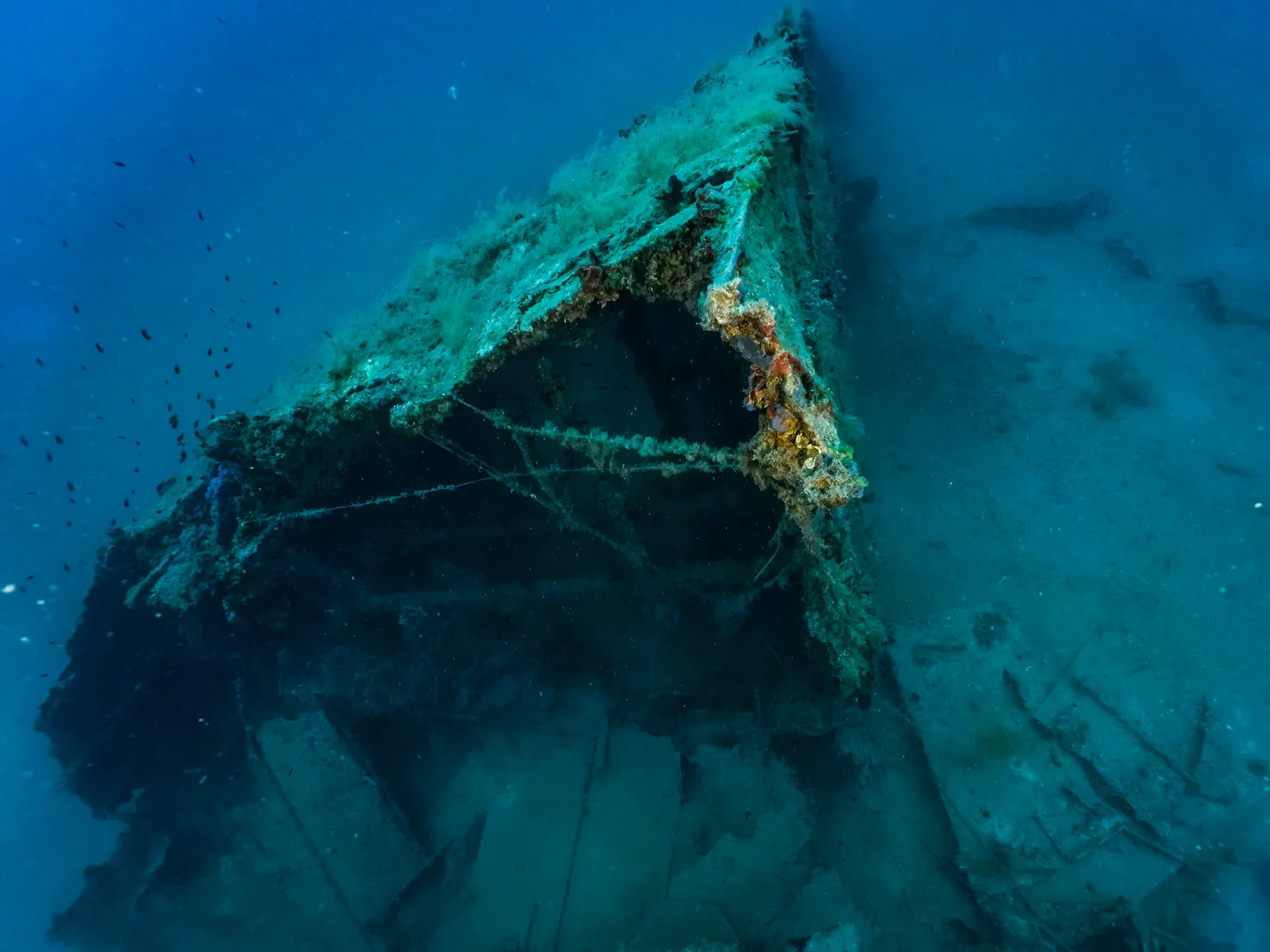
The bow remains partly buried and retains its anchor winch. The central section has collapsed, exposing parts of the interior, while supports associated with the vessel’s two propeller shafts can still be identified at the stern.
The absence of propellers and parts of the original armament is unsurprising because the vessel was disarmed before being used as a target. Other losses may have resulted from salvage, corrosion or unauthorized removal after the sinking.
A marine habitat
More than six decades underwater have transformed the wreck into an artificial reef. Marine growth covers much of the surviving steelwork, while the fractured hull provides shelter for fish and other organisms.
The sandy surroundings emphasize the outline of the vessel and its machinery, but sediment can also conceal smaller components. Currents, storms and the movement of sand continue to alter which parts of the wreck are visible.
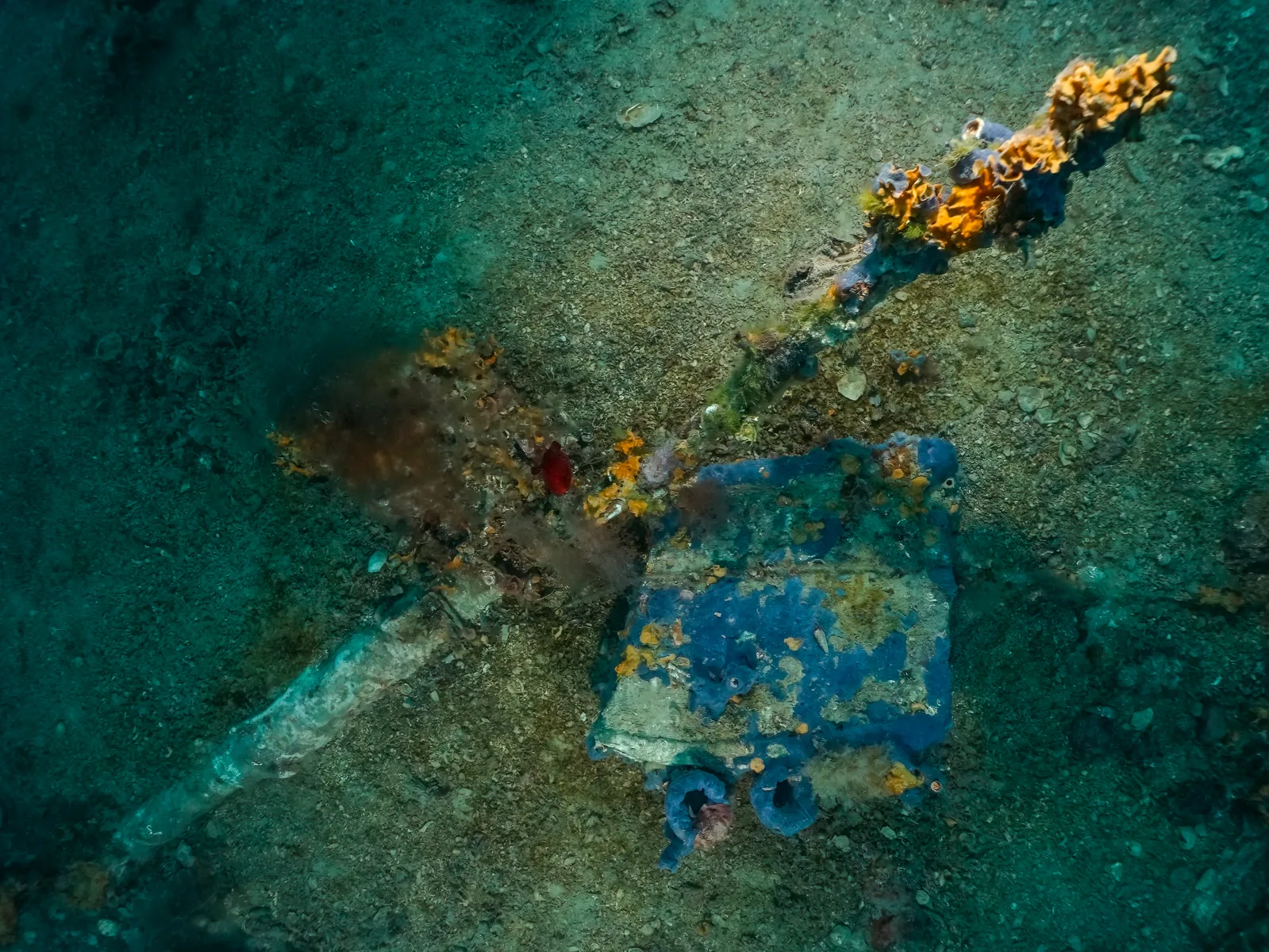 SpitfireAircraft · Cape Kabala
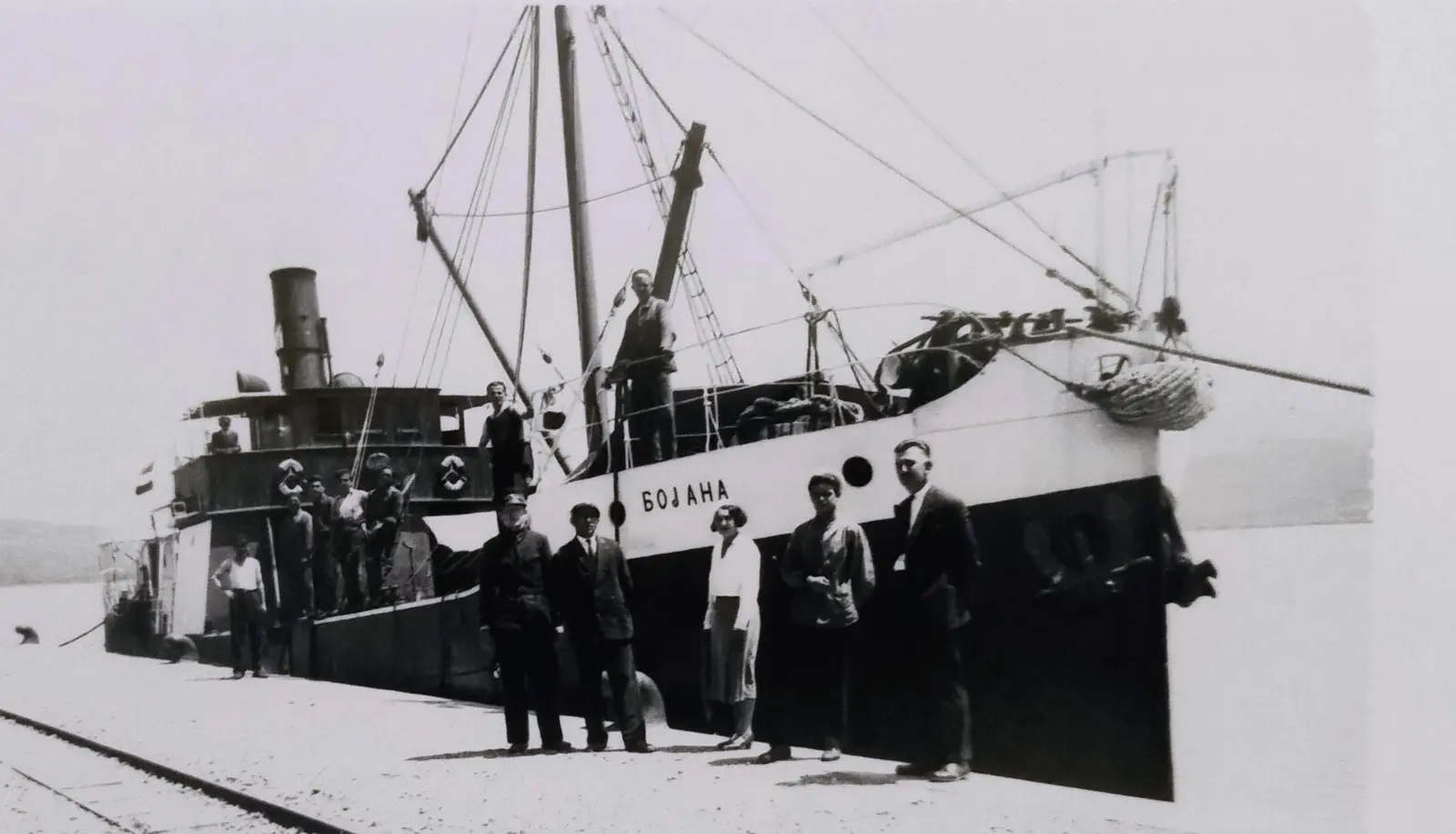 BojanaSteamship · Ulcinj coast
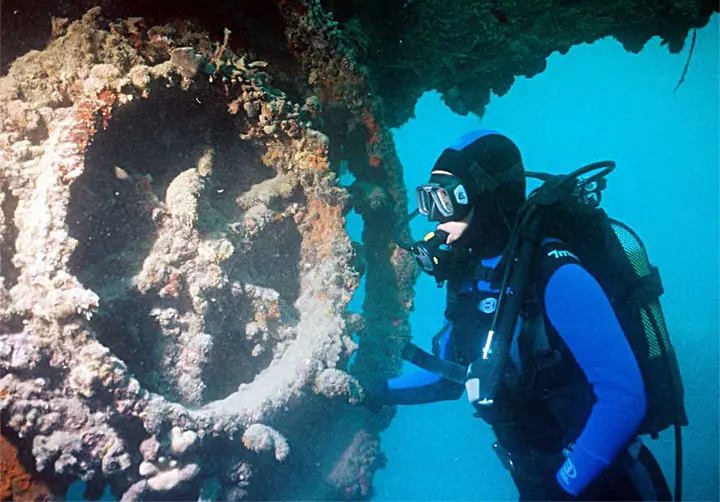 CarolaSteamship · Near Cape Đeran
 Patrol Boat PBR-512Vessel · Žanjice Bay