The Supermarine Spitfire Mk IX Trop crashed near Cape Kabala in March 1944 after being hit during an attack in Boka Kotorska Bay. The pilot escaped by parachute and was captured. The remains are scattered and include the Merlin engine, a wing, tail components and the cockpit. The site lies in a navigation channel and is not open for diving.
Aircraft / Cape Kabala
Spitfire
An aircraft’s story, preserved beneath the bay.
Original photogrammetry4.7 MB · interactive 3D · 3 points of interest
Explore Spitfire.
The real site, captured in three dimensions.
Points of interest
Select a point to fly to it on the scan and read what divers find there.
From the collection
Closer to the evidence.
The research narrative
A deeper reading.
Supermarine Spitfire Mk IX Trop
Scattered across the sandy seabed near Cape Kabala, at the entrance to the Bay of Kotor, lie the remains of a British Supermarine Spitfire. The aircraft was reportedly damaged by anti-aircraft fire during an Allied attack on 7 March 1944 and crashed into the sea after its pilot bailed out. Today, its engine, wing, tail and other components form one of the most unusual underwater archaeological sites in Montenegro.
An iconic fighter
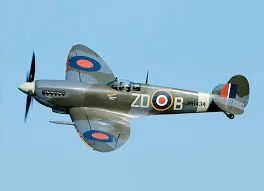
The Supermarine Spitfire was one of the most important Allied fighter aircraft of the Second World War. Designed by Reginald J. Mitchell and developed by Supermarine Aviation Works in Britain, it evolved from the experimental prototype K5054, powered by the Rolls-Royce PV-12 engine that later became known as the Merlin.
The prototype made its first flight on 5 March 1936, while the first production Spitfires entered Royal Air Force service in August 1938. Its elliptical wings, powerful engine and responsive controls made the aircraft highly effective as both an interceptor and an air-superiority fighter.
The Spitfire became famous during the Battle of Britain in 1940, but its operational history extended far beyond the defence of the United Kingdom. Successive versions served over North Africa, Malta, Italy, the Balkans, Western Europe and Asia, performing interception, escort, reconnaissance and ground-attack missions.
The Mark IX
The Spitfire Mk IX was developed in 1942 in response to the appearance of the German Focke-Wulf Fw 190, whose performance had challenged earlier British fighters. It combined the established Spitfire airframe with a more powerful Rolls-Royce Merlin engine equipped with a two-stage, two-speed supercharger.
Although initially conceived as an interim solution, the Mk IX became one of the most successful and widely produced Spitfire variants. Different versions were optimized for low-, medium- or high-altitude operations, while armament commonly included 20-millimetre cannon and Browning machine guns.
The designation “Trop” indicated equipment adapted for operations in warmer and dustier environments, especially an improved air-intake filtration system. It did not represent an entirely separate aircraft model. Tropical equipment was important in the Mediterranean, where dust and sand could cause serious damage to an unprotected engine.
War reaches Boka
After the Axis invasion of Yugoslavia in April 1941, the Bay of Kotor became an important military and naval area under Italian occupation. Following Italy’s armistice with the Allies in September 1943, German forces took control of the bay, its ports, coastal batteries and former seaplane facilities.
From bases in southern Italy, Allied aircraft increasingly attacked German shipping, naval installations and transport routes along the eastern Adriatic. The difficult terrain around the Bay of Kotor, combined with powerful coastal defences, made such operations particularly hazardous.
Aircraft approaching the bay had to cross a narrow coastal zone surrounded by steep mountains. Anti-aircraft batteries could engage them from several directions, while the confined geography left damaged aircraft with few places to make an emergency landing.
The final mission
According to local heritage documentation, the Spitfire preserved near Cape Kabala was lost on 7 March 1944 during an attack on a German-held seaplane or naval facility in the Bay of Kotor. The aircraft was reportedly struck by anti-aircraft fire and began trailing dense black smoke.
The damaged fighter continued flying toward the entrance to the bay, passing the area around Rose and heading toward the Prevlaka Peninsula. As it lost altitude near Cape Kabala, the pilot abandoned the aircraft and descended by parachute into the sea.
Spitfires did not have ejection seats, so descriptions stating that the pilot “ejected” are technically incorrect. He would have opened or released the cockpit canopy, climbed or rolled out of the aircraft and deployed his parachute manually.
Local accounts state that German vessels recovered the pilot from the water and transported him to Zelenika as a prisoner of war. However, his name, unit and the aircraft’s serial number have not yet been securely established in the accessible historical record. These details should therefore remain open pending research in British operational record books, aircraft-loss registers and German prisoner-of-war documentation.
Impact with the sea
After the pilot bailed out, the aircraft continued in an uncontrolled descent and struck the surface near Cape Kabala. The force of the impact broke the Spitfire into numerous sections, which settled across an area of sandy seabed.
Unlike a ship that may reach the bottom as a largely complete structure, a fast-moving aircraft usually fragments on impact. The distribution of components can nevertheless preserve valuable evidence about its direction of travel, angle of impact and condition immediately before the crash.
The site should therefore be understood as a single archaeological context, even though its remains are spread across the seabed. The position of every fragment—including apparently insignificant pieces of sheet metal—may contribute to reconstructing the final moments of the aircraft.
The site today
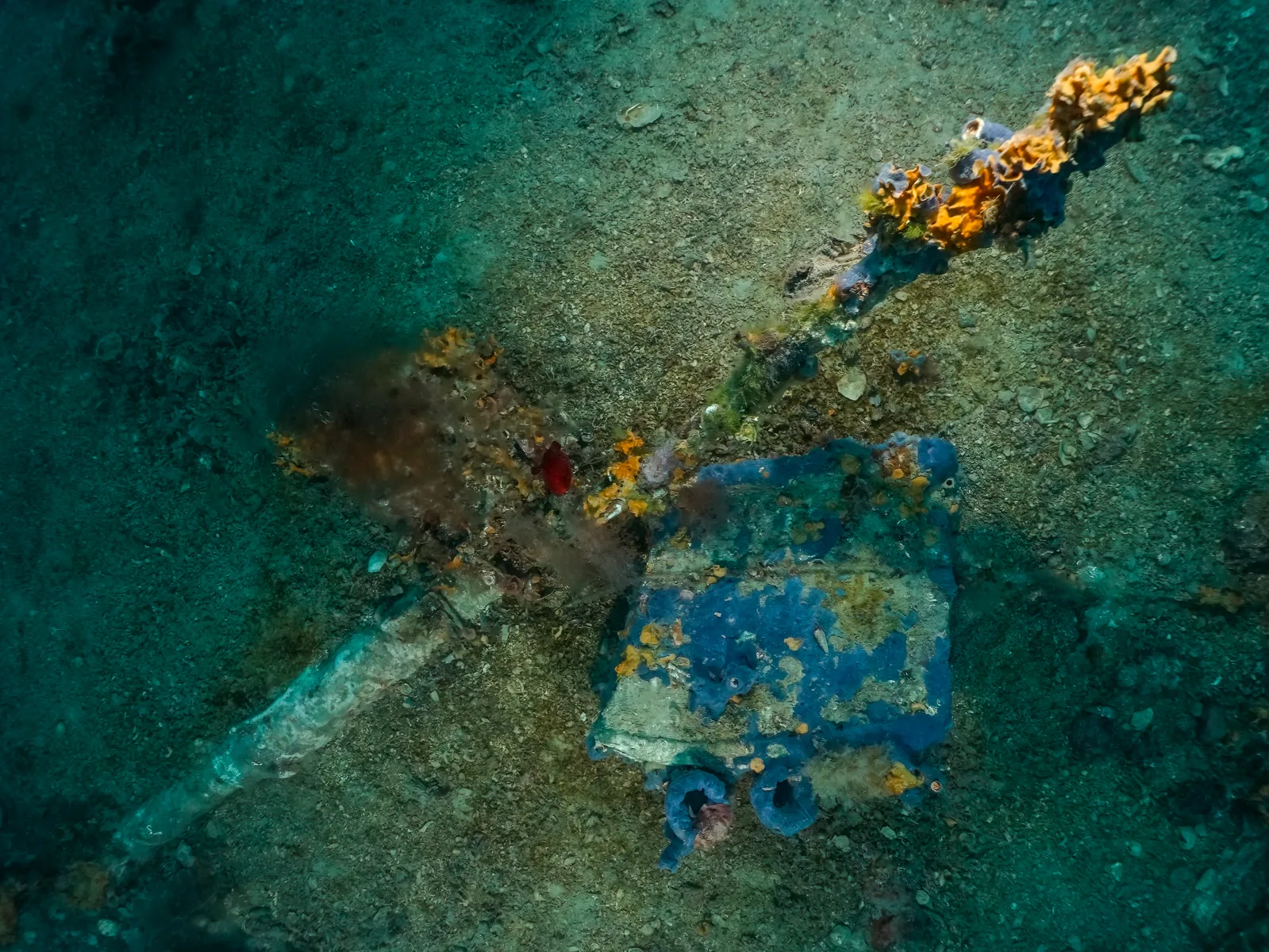
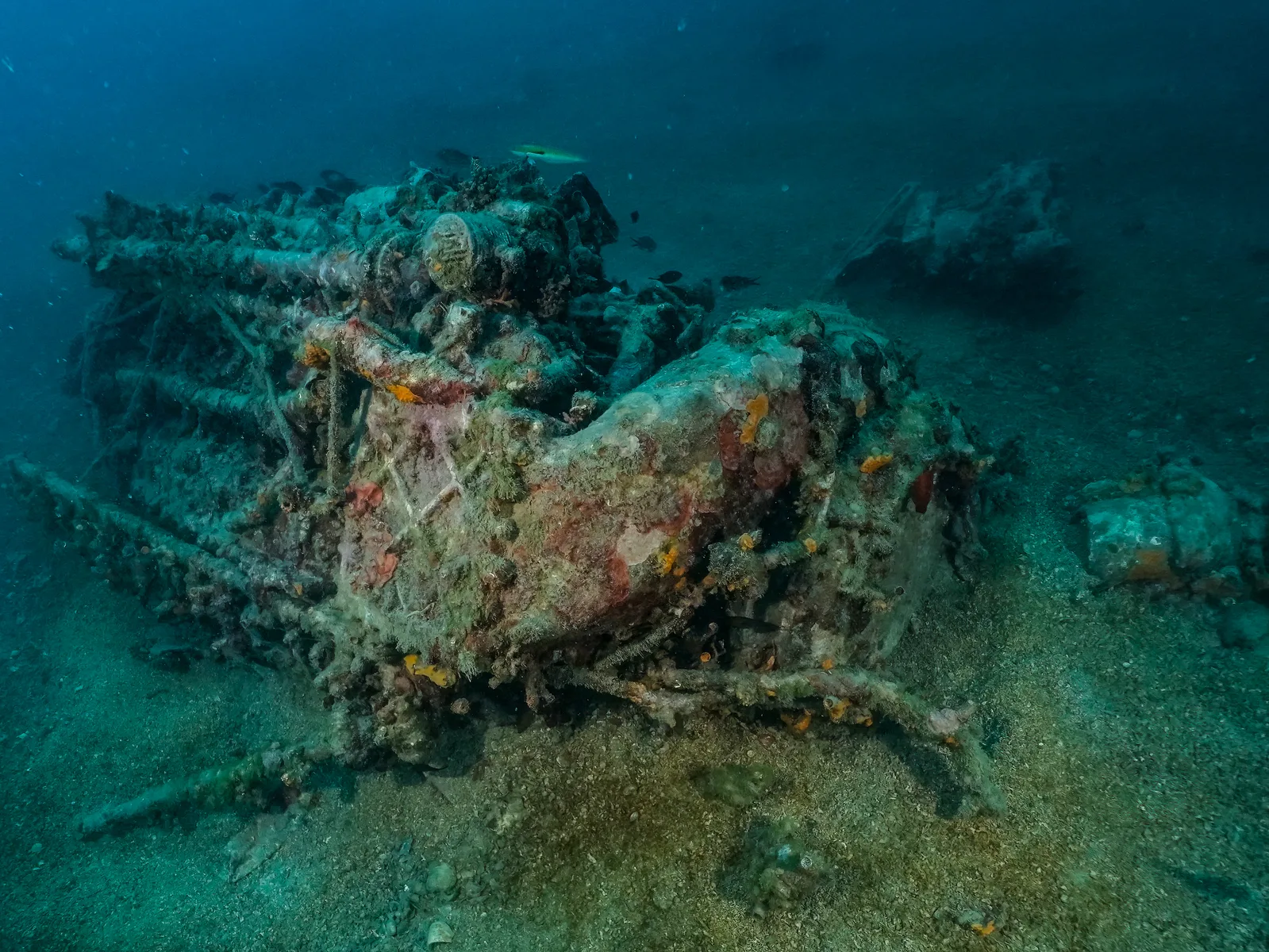
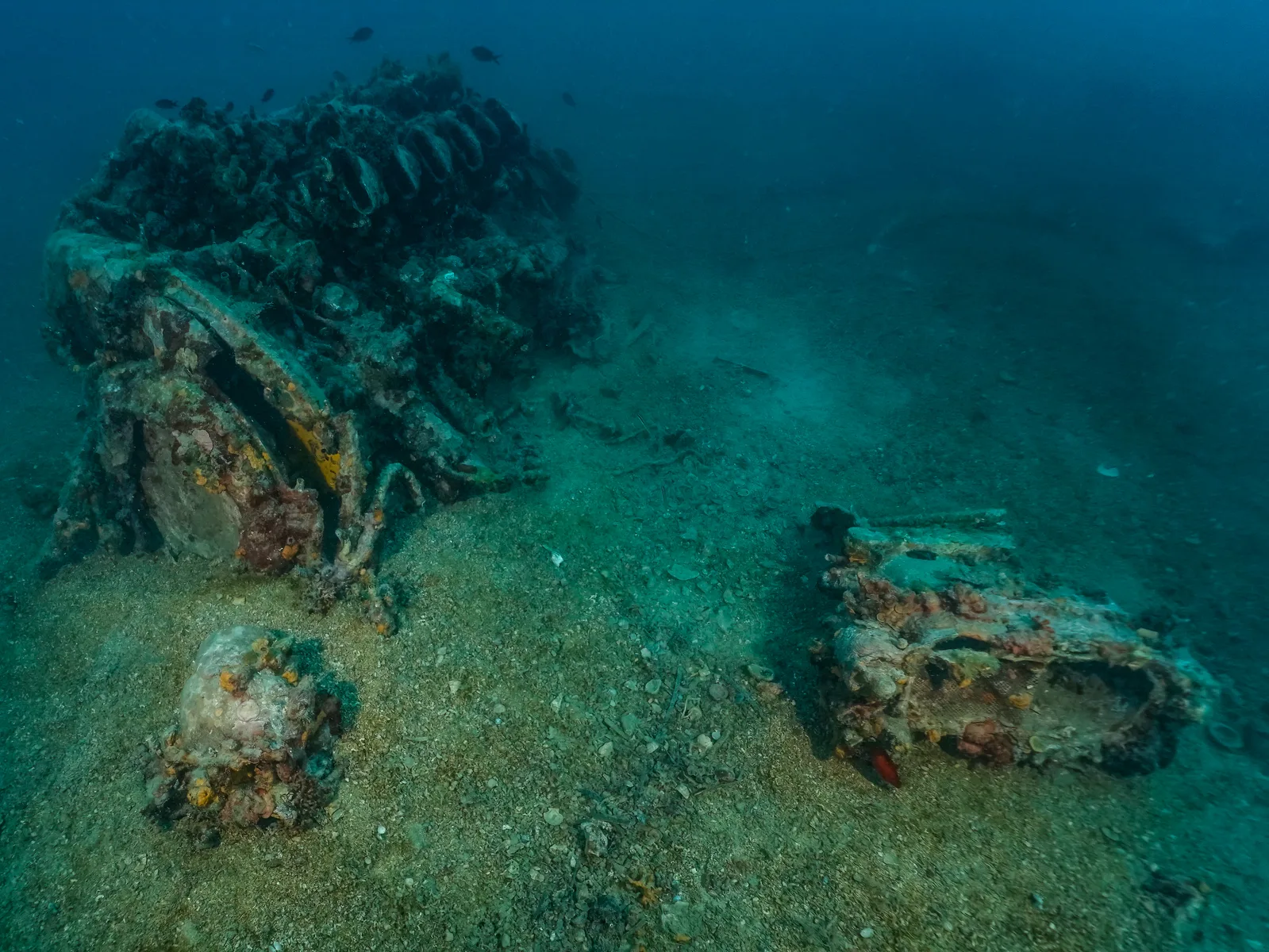
The remains lie at a depth of approximately 32 metres, reportedly distributed across an area around 40 metres in diameter. The Rolls-Royce Merlin engine is the largest and most recognizable component, while sections of the airframe are scattered across the surrounding sand.
Close to the engine are pieces of aluminium skin, structural framework and mechanical installations. One wing, sections of the tail with the rudder and elevators, landing-gear components and parts of the central fuselage and cockpit have also been identified. Two aircraft machine guns are reported among the surviving material.
Because the airframe was built primarily from relatively light aluminium alloys, it has deteriorated differently from the steel shipwrecks found along the Montenegrin coast. Thin panels may be fragmented, bent or partly buried, while heavier components such as the engine, weapons and landing gear remain more prominent.
Reading the remains
The Merlin engine provides the clearest visual focus of the site. Around it, surviving electrical, hydraulic and mechanical components reveal the technological complexity concealed beneath the Spitfire’s streamlined exterior.
The tail section preserves elements associated with flight control, including the rudder and elevators. The surviving wing and landing-gear components help communicate the aircraft’s original scale, while smaller pieces of cockpit equipment may provide evidence of its precise version and operational configuration.
Systematic archaeological recording could help determine whether the aircraft has been correctly identified as a Spitfire Mk IX and whether it carried tropical equipment. Diagnostic components, manufacturing plates and stamped serial numbers could potentially identify the production batch, individual aircraft and RAF or Allied squadron to which it belonged.
Research questions
The general identification of the site as a Spitfire Mk IX Trop is used in University of Montenegro and regional underwater-heritage materials. Several important historical details nevertheless require additional archival verification:
The aircraft’s military serial number
The pilot’s name, rank and nationality
The squadron and air force operating the aircraft
The exact target and purpose of the mission
The aircraft’s take-off base in southern Italy
The German unit responsible for the anti-aircraft fire
The pilot’s subsequent prisoner-of-war history
The precise time and official circumstances of the loss
Until these questions are resolved, the account should distinguish between physically documented evidence, local historical testimony and details confirmed by contemporary military records.
Aviation beneath the sea
The Cape Kabala Spitfire expands the story of Montenegro’s underwater landscape beyond ships and submarines. It records the moment when aerial warfare reached the fortified entrance to the Bay of Kotor and preserves the remains of a technology that transformed the Second World War.
The site also carries a human story. A pilot survived the destruction of his aircraft, descended into enemy-controlled waters and became a prisoner of war. Although his identity remains uncertain, the material remains of his final mission survive on the seabed.
Through archival research, archaeological documentation and carefully managed access, the Cape Kabala Spitfire can connect aviation history, underwater archaeology and public education while remaining protected in its original setting.
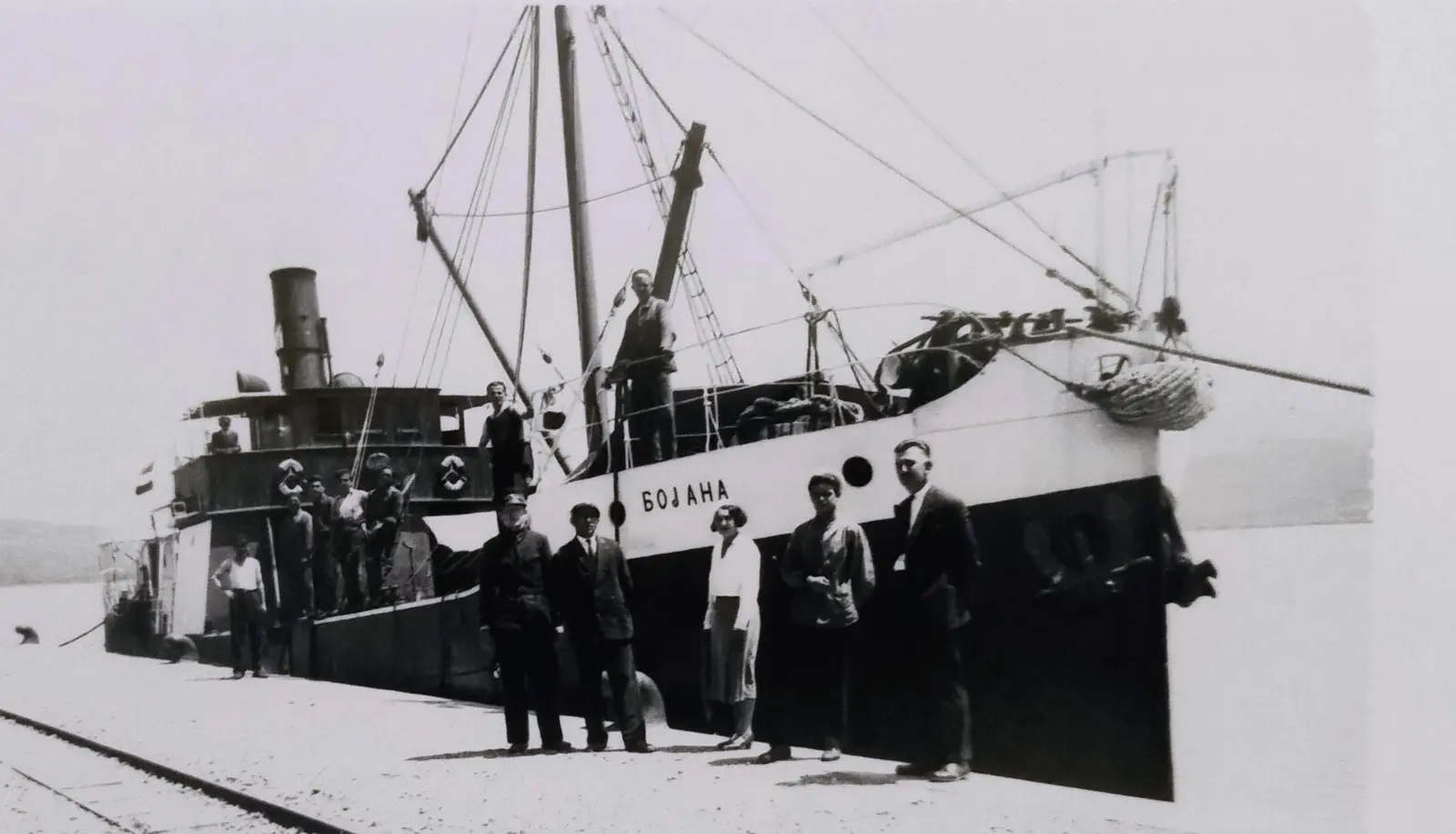 BojanaSteamship · Ulcinj coast
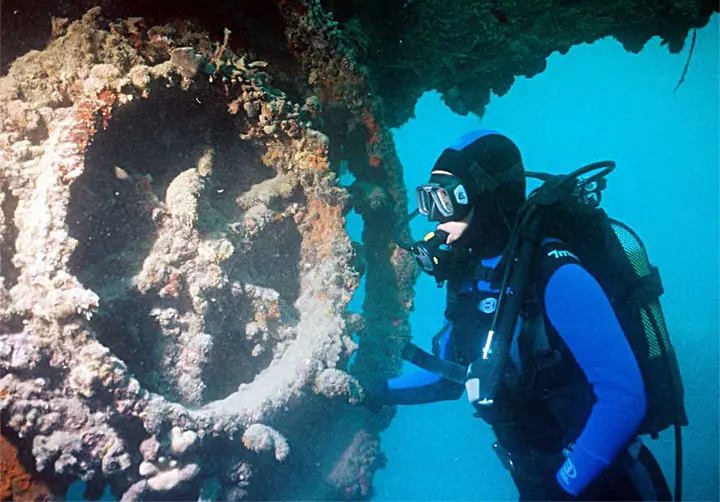 CarolaSteamship · Near Cape Đeran
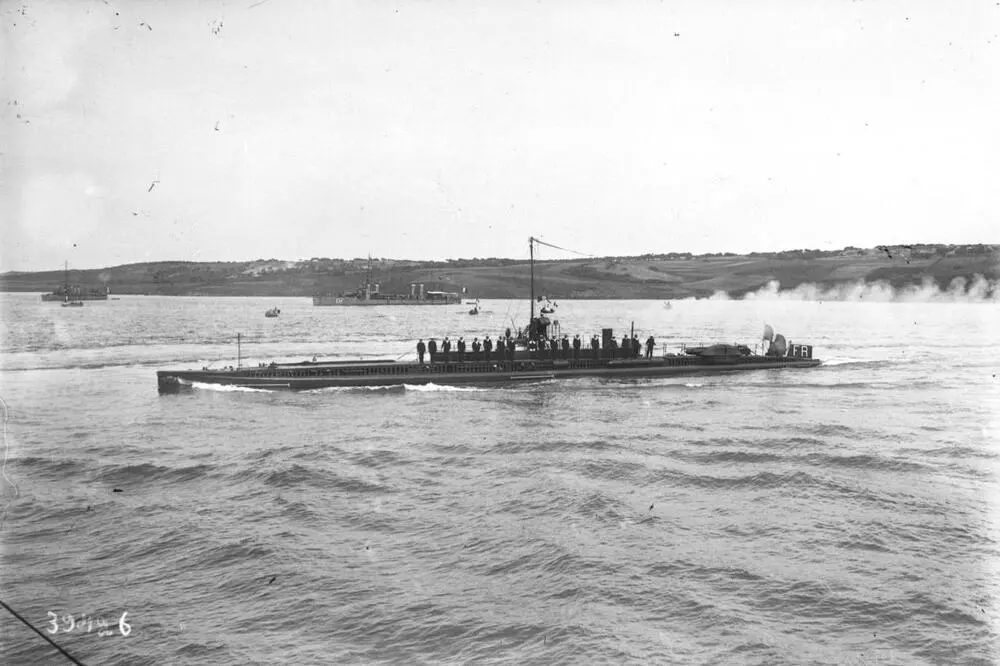 Fresnel Q65Submarine · Ada Bojana
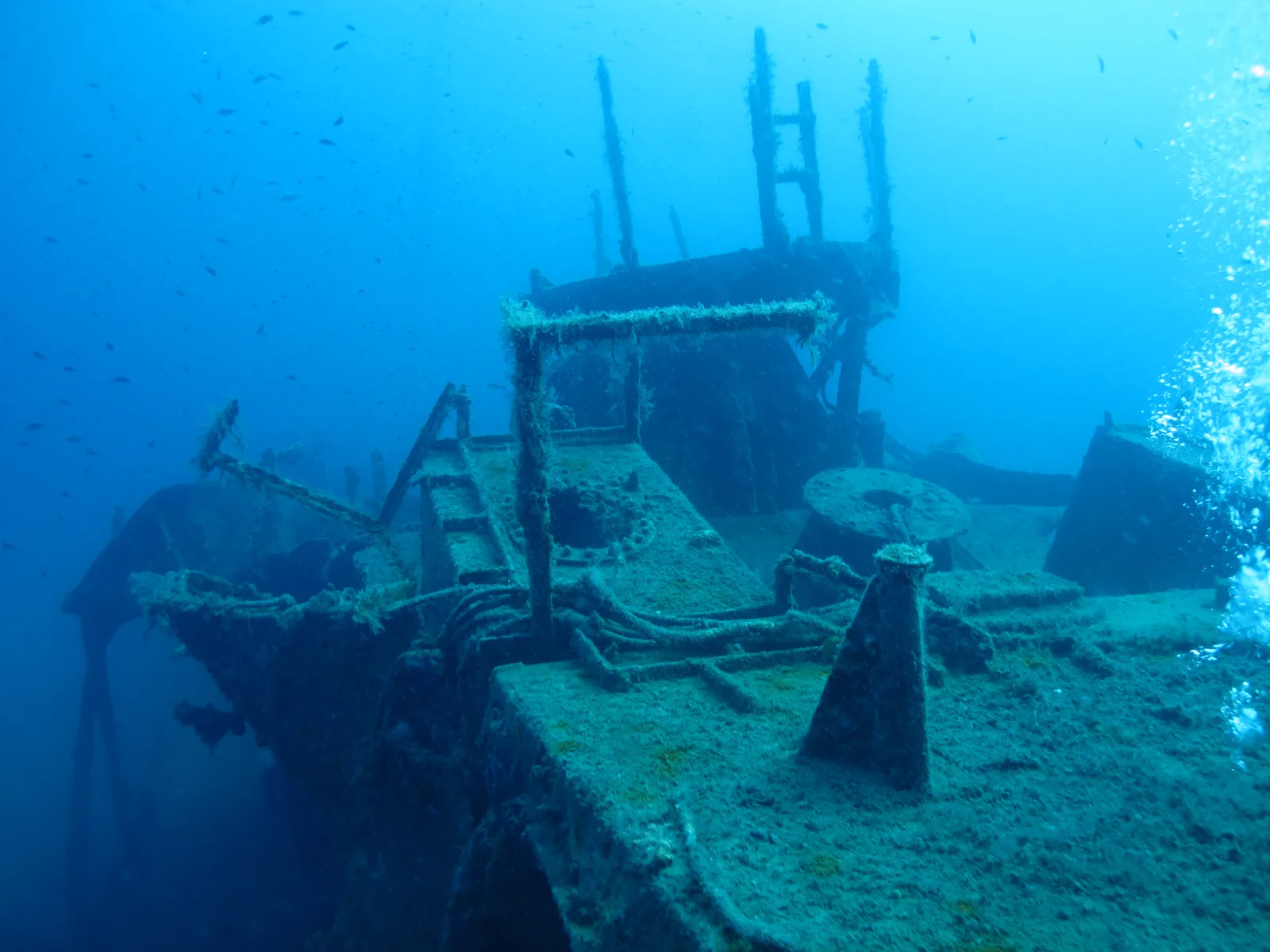 Patrol Boat PBR-512Vessel · Žanjice Bay