Beneath the waters of the Port of Bar lie the heavily damaged remains of Rumija, the former royal yacht of Prince—and later King—Nikola I Petrović-Njegoš. Once the largest steam-powered vessel sailing under the Montenegrin flag, Rumija served not only as a royal yacht but also as a military transport and tug before an Austro-Hungarian naval raid destroyed it on 2 March 1915.
Royal yacht / Port of Bar
Rumija
Beneath the waters of the Port of Bar lie the heavily damaged remains of Rumija, the former royal yacht of Prince—and later King—Nikola I Petrović-Njegoš.
From the collection
Closer to the evidence.
The research narrative
A deeper reading.
Royal Yacht Rumija
Beneath the waters of the Port of Bar lie the heavily damaged remains of Rumija, the former royal yacht of Prince—and later King—Nikola I Petrović-Njegoš. Once the largest steam-powered vessel sailing under the Montenegrin flag, Rumija served not only as a royal yacht but also as a military transport and tug before an Austro-Hungarian naval raid destroyed it on 2 March 1915.
Built as Zaza
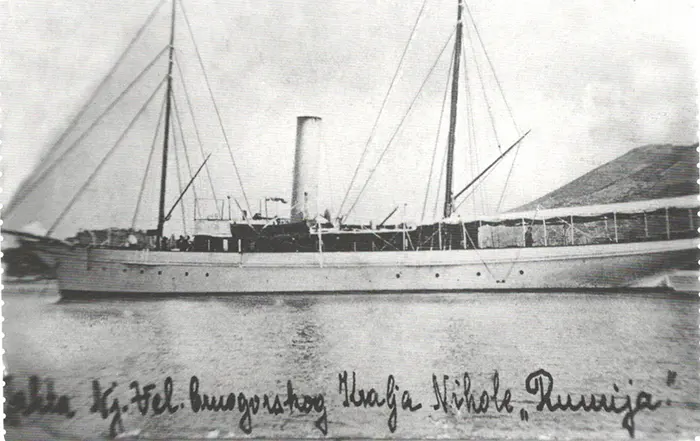
The vessel began its life in Scotland under the name Zaza. It was launched on 11 August 1900 by John Reid & Co. at Whiteinch, near Glasgow, and had been commissioned by the prominent British industrialist and shipbuilder Sir William Beardmore. Its shipyard construction number was 321.
Zaza was a classically proportioned steel steam yacht with two masts and an auxiliary sailing rig. It measured approximately 41.8 metres in length and 6.1 metres across the beam, with a draught of about 2.5 metres and a gross registered tonnage of approximately 185 tons.
A three-cylinder triple-expansion steam engine built by Muir & Houston of Glasgow drove a single propeller. The figure of 65 horsepower found in contemporary descriptions probably refers to nominal horsepower—a registry measurement—rather than the engine’s actual mechanical output.
A royal gift
At the end of 1904, Ottoman Sultan Abdülhamid II acquired the yacht and presented it to Prince Nikola I of Montenegro. The gift reflected the diplomatic relationship between the Ottoman Empire and Montenegro during a period in which both states sought to stabilize relations following decades of conflict.
An Ottoman crew delivered Zaza to Pristan, the settlement from which modern Bar developed, on 1 January 1905. Two days later, the yacht was formally transferred to its Montenegrin crew together with the Sultan’s decree of donation. Captain Niko Janković of Igalo became its first Montenegrin commander, leading a crew of approximately 14 men.
Prince Nikola made one of his first recorded voyages aboard the yacht on 23 March 1905, when he ceremonially marked the beginning of construction work on Bar’s new breakwater. On 28 July, Crown Prince Danilo travelled aboard the vessel from Bar toward the mouth of the Bojana River and decided that it should be renamed Rumija, after the mountain overlooking Bar.
The royal yacht
As the largest and most prestigious vessel in Montenegro, Rumija became a visible symbol of the country’s maritime ambitions. Montenegro possessed only a small merchant fleet and no substantial navy, making the yacht especially important for official journeys, diplomatic ceremonies and connections between the royal court and the coast.
The ship was also associated with a personal tragedy of the Petrović-Njegoš dynasty. The seriously ill princes Stanislav and Stevan spent time aboard Rumija in the Bay of Kotor in late 1907. Stanislav died aboard the yacht on 4 January 1908, while Stevan died in Cannes less than two months later.
From yacht to transport
During the Balkan Wars of 1912–1913, Rumija was adapted to the practical demands of wartime. It transported troops and military supplies and operated between Montenegrin ports and San Giovanni di Medua—present-day Shëngjin—in northern Albania.
After the First World War began in 1914, the yacht returned to military service. It transported Montenegrin and Serbian soldiers, carried supplies and towed smaller sailing vessels and barges loaded with food, ammunition and other essential materials.
Its value came less from its speed or armament than from its steam engine and towing ability. As the only larger steam-powered vessel under direct Montenegrin control, Rumija played an important role in moving supplies along a coast increasingly threatened by Austro-Hungarian warships, submarines, aircraft and mines.
The blockade of Montenegro
Austria-Hungary’s principal southern Adriatic naval base was at Cattaro, present-day Kotor. From there, its warships sought to prevent France and Britain from delivering food, weapons and military equipment to Montenegro.
Bar was Montenegro’s principal maritime supply point. Its harbour installations, warehouses and coastal roads supported both the army and the civilian population, while Rumija helped redistribute material to smaller ports and anchorages.
The Austro-Hungarian Navy consequently regarded the yacht as a strategically important transport asset rather than simply a royal pleasure craft. By February 1915, its forces had begun making deliberate attempts to intercept, capture or destroy it.
Earlier encounters
On 14 February 1915, Austro-Hungarian aircraft reportedly observed Rumija towing a smaller vessel near Cape Mendra. Torpedo boats TB 15 and TB 68 were sent to intercept it, but the yacht reached the protection of Bar before they arrived.
TB 68 attempted to approach the harbour but came under accurate fire from the Montenegrin coastal battery at Ratac. The torpedo boat withdrew toward the Bay of Kotor together with TB 15 and the destroyer SMS Csikós, which was also engaged by Montenegrin batteries around Volujica and Šušanj.
A second dangerous encounter reportedly occurred on 21 February. Under Captain Ivo Đokić of Bar, Rumija was returning from Shëngjin with 87 Montenegrin volunteers who had arrived from the United States, while towing two smaller sailing vessels.
After enemy vessels were sighted near the mouth of the Bojana, Đokić released the towed vessels and brought Rumija into shallow coastal waters. He temporarily grounded the yacht bow-first on Mala Plaža at Ulcinj, allowing the volunteers to disembark, before refloating the ship under cover of darkness and returning south to Shëngjin.
The final arrival
Before dawn on 1 March 1915, Rumija departed Shëngjin for Bar. It arrived later that day and anchored inside the harbour with both bow anchors deployed and its stern secured to the principal wooden pier.
Austro-Hungarian seaplanes observed the yacht that afternoon. The Fifth Naval Division in the Bay of Kotor decided to launch a surprise attack that same night, with three principal objectives: destroy or capture Rumija, damage the harbour installations and eliminate supplies stored for the Montenegrin army.
The raid on Bar
Around midnight between 1 and 2 March, the destroyers SMS Csikós, Streiter and Ulan departed the Bay of Kotor with the torpedo boats TB 57, TB 66 and TB 67. The destroyers were to engage the coastal batteries from outside the harbour, while the smaller torpedo boats entered the port and carried out the attack at close range.
The squadron approached Bar during a stormy night of heavy rain, strong southwesterly wind and rough seas. At approximately 02:30, the destroyers took up positions outside the harbour and exchanged fire with Montenegrin batteries at Volujica and around Šušanj.
Searchlights aboard the destroyers illuminated and disrupted the coastal gun positions. Under cover of darkness, weather and artillery fire, the three torpedo boats entered the harbour from the direction of Crni Rt.
Attack on the harbour
Soon after entering the harbour, TB 67 launched a 450-millimetre torpedo at the main wooden pier. The explosion struck the structure approximately one-third of the way along its length and caused extensive damage.
TB 66 approached another section of the harbour and laid three moored naval mines near the warehouses. A demolition party went ashore, entered the customs building and nearby storage facilities, and discovered substantial quantities of recently delivered grain.
The Austro-Hungarian sailors placed explosive charges and set fire to the warehouses and their contents. Meanwhile, the remaining torpedo boats used their guns and machine guns to suppress Montenegrin troops firing from the shore.
Boarding Rumija
Despite the rough conditions, TB 57, assisted by TB 67, succeeded in coming alongside Rumija. The yacht’s crew had already abandoned it, leaving the vessel unmanned.
The executive officer of TB 57, Paul Meixner, boarded the yacht with eight sailors. They cut its stern lines and attempted to prepare it for towing. Because Rumija had no steam pressure, however, its anchor windlass could not be operated and the two bow anchors could not be raised.
The torpedo boats pulled the yacht away from the pier and turned it through approximately 180 degrees. The boarding party then attempted to sever the anchor chains with explosive charges.
The first attempt failed when a sudden gust damaged the windlass brake and the lit charges fell into the water. A second attempt successfully broke the chains, but the increasingly powerful wind began driving the yacht uncontrollably toward the northeastern shore.
Destruction of the yacht
With little room to manoeuvre inside the harbour, towing Rumija into the open sea became too dangerous. Montenegrin coastal artillery was also recovering from the initial surprise and beginning to fire more accurately at the torpedo boats.
The commander of TB 57, Lieutenant Albert Heinz-Erian, therefore abandoned the attempt to capture the yacht. He recalled the boarding party and ordered his torpedo crew to sink Rumija.
At approximately 03:45, from a reported distance of about 200 metres, TB 57 fired a torpedo that struck the yacht near amidships. The explosion broke Rumija into two principal sections, and the vessel sank almost immediately.
No members of Rumija’s crew were aboard when it was torpedoed, and the Austro-Hungarian force completed the operation without reported fatalities. The raiders withdrew around 04:00 and returned to the Bay of Kotor at dawn.
Consequences of the raid
The destruction of Rumija deprived Montenegro of its most capable steam-powered transport and towing vessel. Damage to the harbour, the destruction of stored grain and the mines laid near the piers further reduced Bar’s ability to receive Allied supply ships.
Larger vessels could no longer use the harbour safely, and Montenegro increasingly depended on more difficult routes through Ulcinj, the Bojana River and Shëngjin. These alternatives had limited capacity and were exposed to enemy patrols and poor weather.
The raid did not by itself cause Montenegro’s defeat in January 1916. The kingdom’s collapse resulted from a much broader combination of Austro-Hungarian military operations, exhausted manpower, shortages, inadequate transport and the defeat and withdrawal of the Serbian Army. Nevertheless, the loss of Bar’s maritime infrastructure and of Rumija significantly worsened an already critical supply situation.
The wreck today
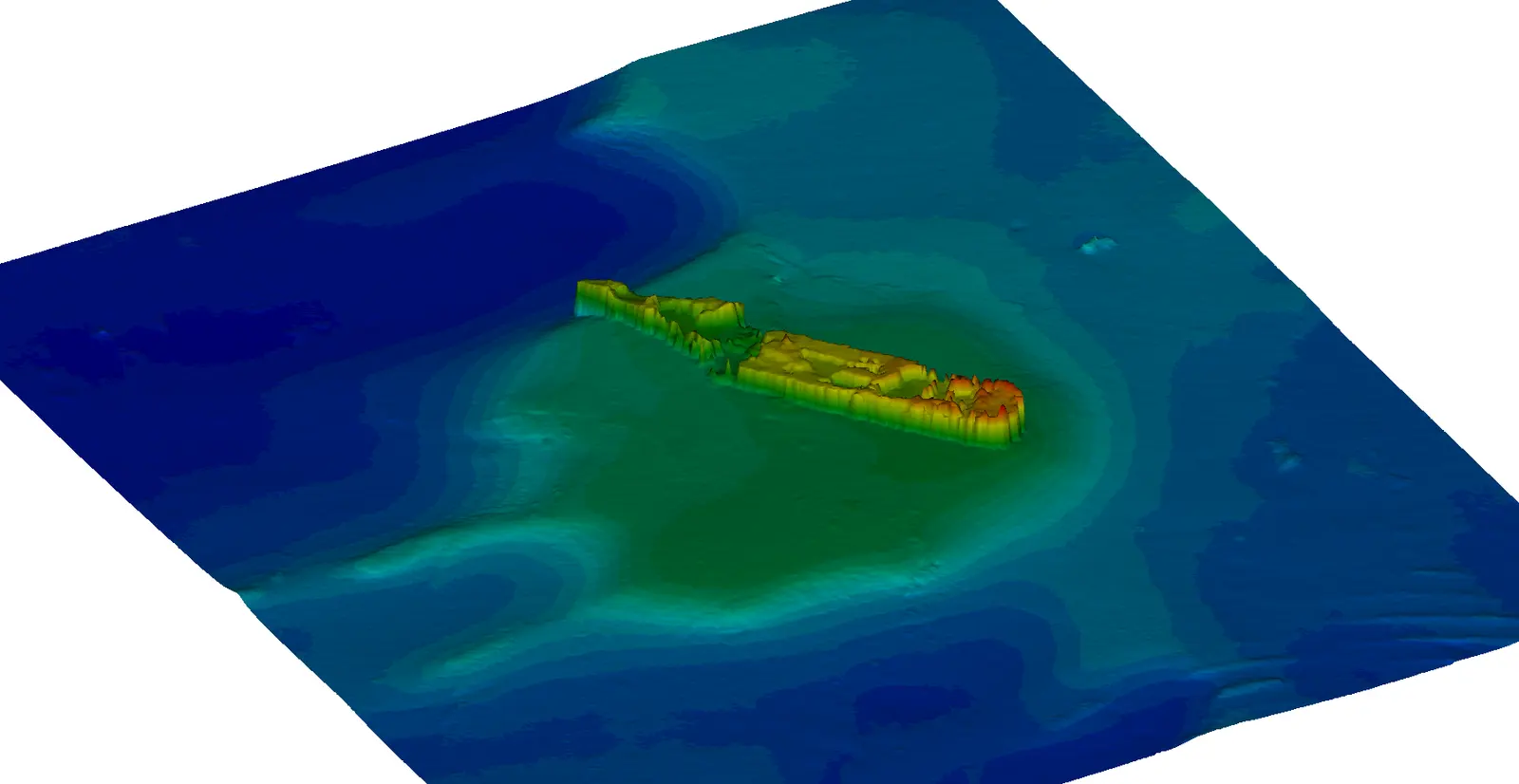
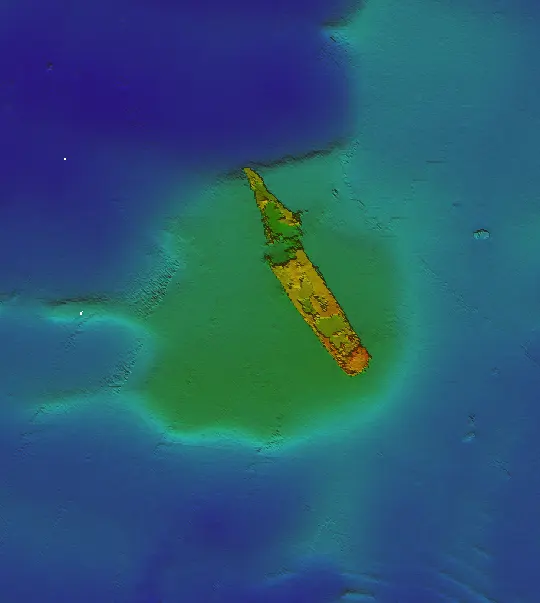
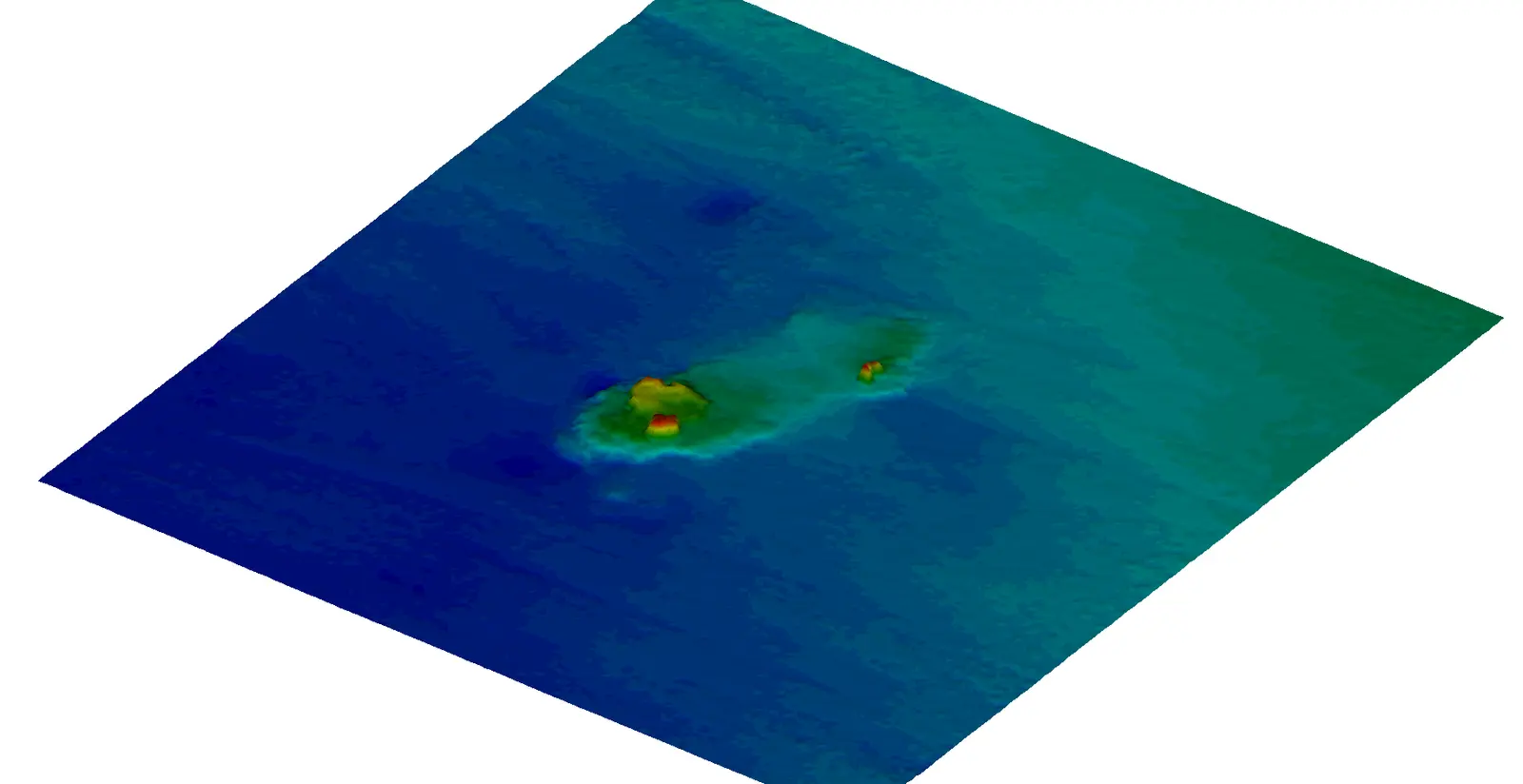
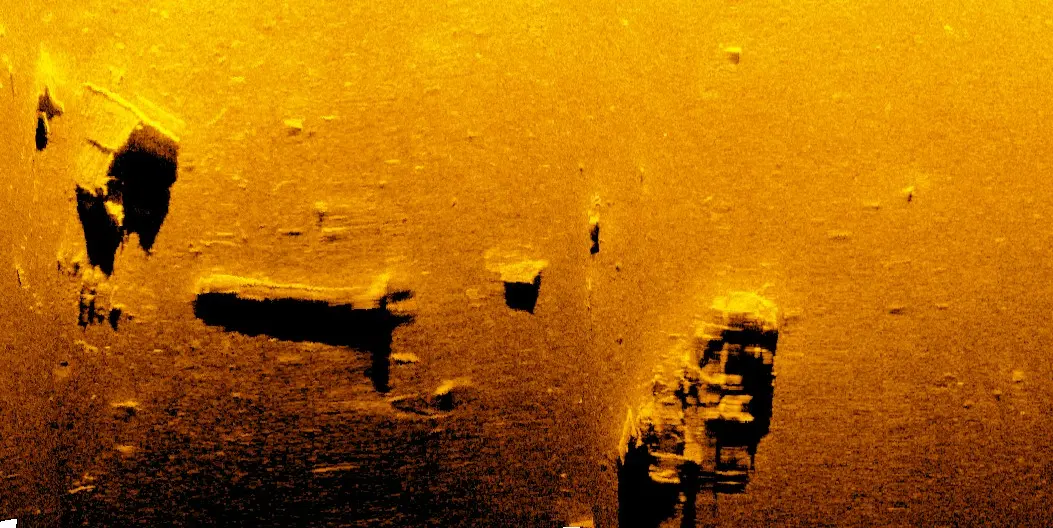
The remains of Rumija lie inside the operational area of the Port of Bar, beneath Volujica. Reported depths across the site range from approximately 8.3 to 12.5 metres.
The wreck is no longer preserved as the recognizable hull of a royal yacht. The torpedo explosion initially broke the vessel apart, while later port construction, anchoring, sediment movement and the passage of large ships caused further destruction.
Because the remains lie within an active commercial harbour, uncontrolled recreational diving is neither appropriate nor safe. Vessel traffic, restricted port access, limited visibility, heavy sediment and industrial activity all complicate archaeological investigation.
Loss of evidence
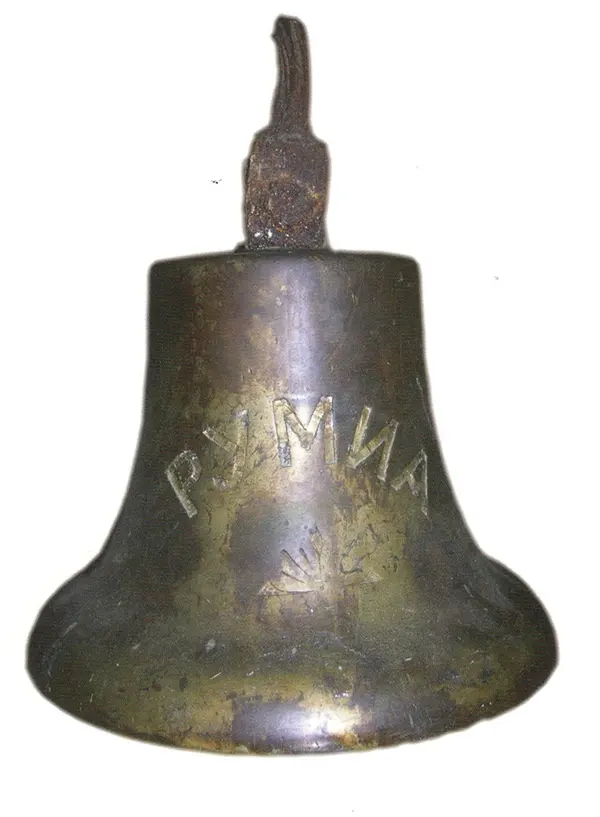
Over the decades, divers removed objects from the wreck. The yacht’s bell is reported to have entered a private collection in Novi Sad, while other components have disappeared without adequate archaeological documentation.
Removing an object from a wreck destroys part of its historical context. A bell, fitting or piece of machinery is most informative when its precise location and relationship to the rest of the vessel are recorded before recovery.
One of the finest surviving models of Rumija is held by the Croatian Maritime Museum in Split. Objects associated with the Austro-Hungarian attack are also preserved outside Montenegro, including a torpedo tube attributed to TB 67 in the Italian War History Museum at Rovereto.
Protection and research
The wreck of Rumija was reportedly designated as protected cultural property in 1967. That status reflects its importance to Montenegro’s political, royal, maritime and military history.
Its heavily disturbed condition does not reduce its cultural value. The surviving structure, debris field and buried material may still preserve evidence of the vessel’s construction, conversion to military service, torpedo damage and subsequent deterioration.
A comprehensive archaeological survey should combine archival documentation, multibeam sonar, magnetometry, photogrammetry and targeted diver inspection. Because visibility inside the port may be poor, sonar-based documentation could be particularly valuable for mapping the remaining structure.
The investigation should also establish the site’s precise boundaries and assess damage caused by modern port activity. A detailed 3D reconstruction could unite surviving archaeological evidence with shipyard records, historical photographs and the model preserved in Split.
A national maritime symbol
Rumija occupied a unique place in Montenegro’s early twentieth-century history. It served the royal family, marked the development of the Port of Bar, carried soldiers and volunteers, and became an essential link in the kingdom’s wartime supply network.
Its loss transformed a symbol of sovereignty into an underwater archaeological site. Today, the wreck tells a wider story about Montenegro’s struggle to maintain maritime connections during the First World War and about the strategic importance of Bar to both the Entente and Austria-Hungary.
Although the remains cannot easily be opened to diving tourism, digital interpretation can return Rumija to the public. A virtual reconstruction, interactive map and carefully researched exhibition could allow visitors to explore the yacht, follow the 1915 raid and understand why this relatively small ship held such great importance for Montenegro.
Montenegrin owner: Prince and later King Nikola I Petrović-Njegoš
Draught: approximately 2.5 metres
 LitorioMotor sailer · Near Budva
 CetinjeSteamship · Tivat Bay
 GoritiaSteamship · Near Ulcinj
 Patrol Boat PBR-512Vessel · Žanjice Bay