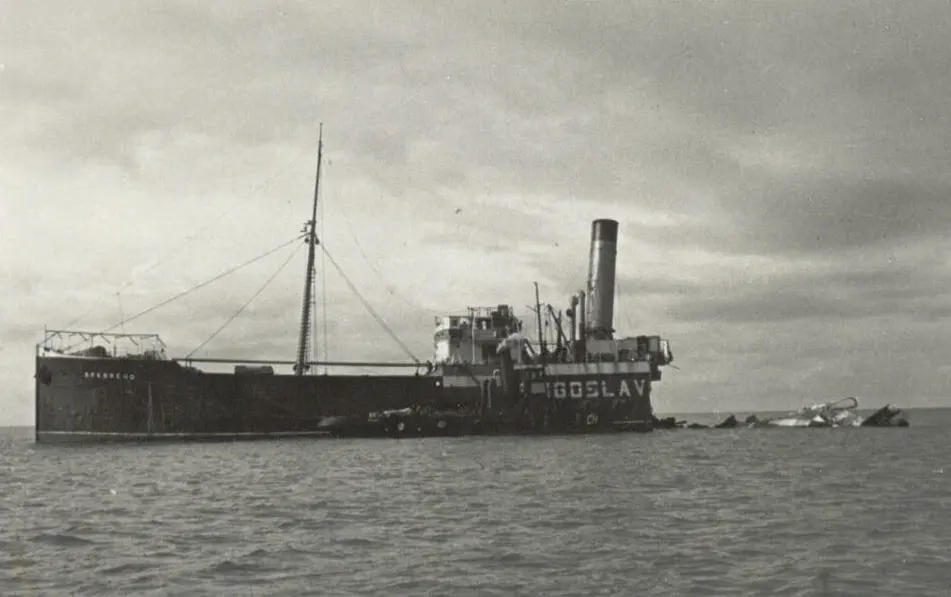
At the end of 1940, the Yugoslav cargo steamship Srebreno ran onto the Kalafat Reef—locally known as Albaneze—near the entrance to the Bay of Kotor. It was the second major vessel lost on the same dangerous reef: 32 years earlier, the Austro-Hungarian destroyer SMS Huszár had grounded there and broken apart.
Steamship / Kalafat Reef
Srebreno
At the end of 1940, the Yugoslav cargo steamship Srebreno ran onto the Kalafat Reef—locally known as Albaneze—near the entrance to the Bay of Kotor.
From the collection
Closer to the evidence.
The research narrative
A deeper reading.
Steamship Srebreno
At the end of 1940, the Yugoslav cargo steamship Srebreno ran onto the Kalafat Reef—locally known as Albaneze—near the entrance to the Bay of Kotor. It was the second major vessel lost on the same dangerous reef: 32 years earlier, the Austro-Hungarian destroyer SMS Huszár had grounded there and broken apart.
Built as Leopoldina
Srebreno began its career under the name Leopoldina. The steel cargo steamship was built in 1901 by John Readhead & Sons at South Shields in northeastern England for a company associated with the prominent Dubrovnik shipowner Ivo Račić. It was launched on 4 September and completed in October of that year.
The ship measured approximately 101 metres in length and 14.4 metres across the beam. It was registered at 3,304 gross register tons and had a cargo capacity of about 5,845 deadweight tons. A three-cylinder triple-expansion steam engine drove a single propeller, giving the vessel a modest service speed of approximately nine knots.
Contrary to some later descriptions, Leopoldina was not registered as a warship in the Austro-Hungarian Navy. It was a privately owned merchant steamship sailing within the Austro-Hungarian commercial fleet.
A Dubrovnik steamship
Leopoldina was originally operated by the Leopoldina Steamship Company of Ragusa, the historical name for Dubrovnik. In 1907, it became part of the fleet of the Unione steam-navigation company, also associated with the Račić family.
During the First World War, the Dubrovnik shipping companies Unione and Napried were consolidated into Dubrovačka parobrodska plovidba. After the creation of the Kingdom of Serbs, Croats and Slovenes in 1918, the company developed into one of the country’s most important long-distance shipping enterprises.
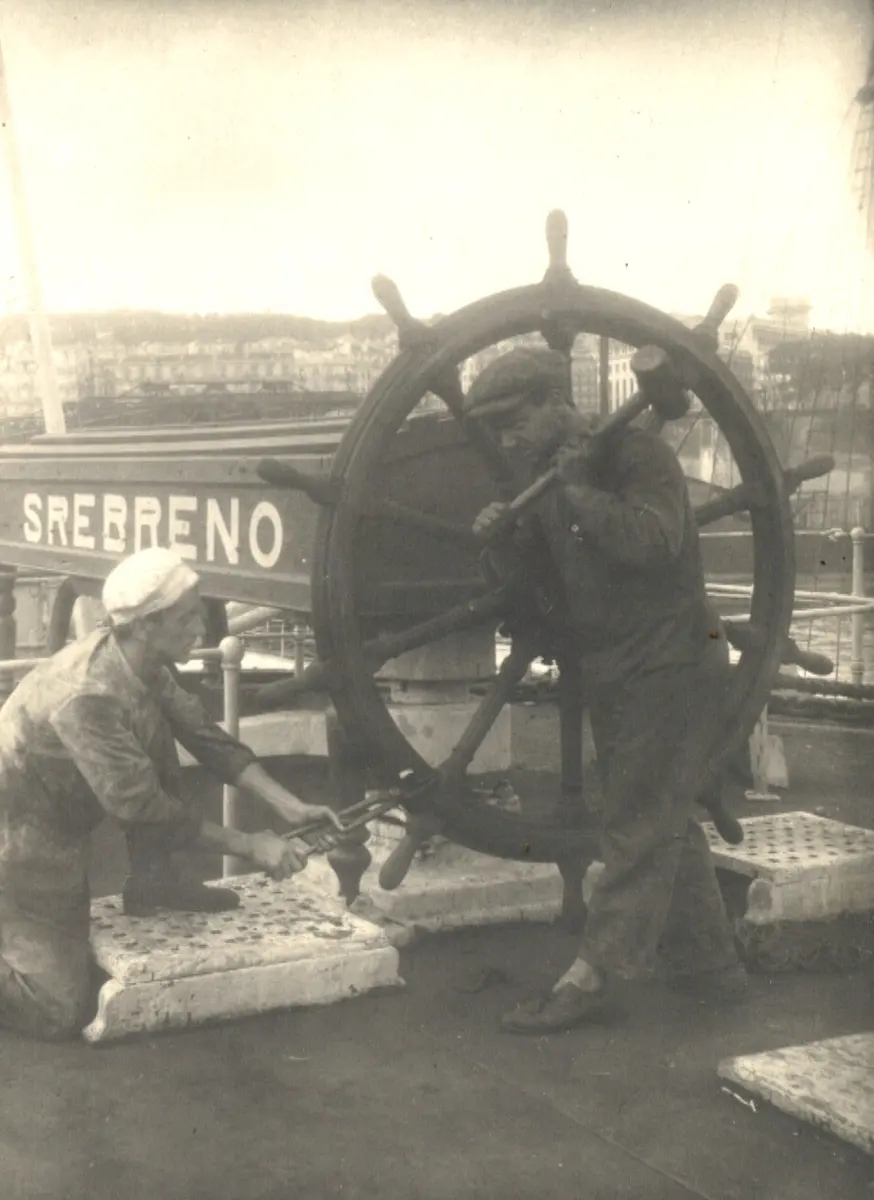
In 1923, the vessel was registered at Dubrovnik and renamed Srebreno, after the coastal settlement southeast of the city. The name “Jugoslavija” displayed on its hull indicated its country of registry rather than forming part of the vessel’s official name.
The final voyage
On 16 December 1940, Srebreno departed Dubrovnik on what would become its final voyage. Its documented destination was Mersin, a major port on the Mediterranean coast of Turkey. A contemporary shipping record describes the vessel as sailing in ballast, meaning that it carried little or no commercial cargo on the outward journey.
Later narratives state that Srebreno was travelling to Turkey to load cargo intended for Philadelphia. This may reflect the commercial purpose of the planned voyage, but it has not been independently confirmed by the accessible ship registers. It is therefore safest to state that the vessel was sailing toward Mersin, probably in ballast, when worsening weather interrupted the journey.
Although the Second World War had already begun elsewhere in Europe, the Kingdom of Yugoslavia remained formally neutral in December 1940. Nevertheless, reports of naval mines, submarines and attacks on merchant shipping created considerable anxiety among crews sailing through the Adriatic and Mediterranean.
Seeking shelter
As Srebreno proceeded south along the Montenegrin coast, severe weather developed in the southern Adriatic. Captain Božo Derikosa abandoned the intended course toward the Strait of Otranto and turned back in search of shelter inside the Bay of Kotor.
The ship entered the Bay of Trašte, where it waited temporarily for conditions to improve. During the early hours of 17 December, it raised anchor and resumed its passage toward the safer inner waters of the Bay of Kotor.
Approximately half an hour after leaving the anchorage, at around 04:30, Srebreno struck the Kalafat Reef. The submerged rock, locally called Albaneze or Seka Albaneze, rises to within approximately one metre of the sea surface and poses a serious hazard during darkness, rough weather and poor visibility.
Grounded on Kalafat
The ship struck the reef with considerable force. A sharp projection penetrated the port side near the engine room and became lodged between the torn steel plates of the hull.
The impact caused immediate alarm. In the darkness and confusion, some crew members initially feared that the vessel had struck a mine or been hit by a torpedo. Inspection soon showed that the damage had been caused by the rock rather than enemy action.
Seawater entered the hull, but the ship’s pumps initially kept the flooding under control. Once it became clear that Srebreno was not in immediate danger of sinking, the crew calmed and the captain informed the shipping company in Dubrovnik.
The salvage attempt
The vessel’s engines could not pull it free. Srebreno had climbed so firmly onto the reef that repeated efforts to move it under its own power achieved little, and outside assistance had to be requested.
Salvage crews attempted to reduce the ship’s weight and prepare it for towing. A more ambitious proposal involved using explosives to remove part of the reef while tugs pulled the vessel into deeper water. The method reportedly drew on experience gained during efforts to refloat the Italian ship Birmania, which had grounded near the islet of Mrduja in 1939.
The plan was never successfully completed. Strong winds, heavy seas and the vessel’s increasingly damaged hull repeatedly interrupted the work. Each movement against the rock enlarged the breach and weakened the steel structure.
Evacuation and loss
As the weather deteriorated again, saving the ship became less important than protecting the people working aboard and around it. The Royal Yugoslav Navy sent the submarine Hrabri and the salvage vessel Spasilac from the naval arsenal in the Bay of Kotor to assist with the evacuation.
All 35 members of Srebreno’s crew, including Captain Derikosa, were ultimately rescued. No loss of life is recorded in the sinking.
According to the best-known account, Spasilac circled the stranded steamship after the evacuation to ensure that nobody remained aboard. Its crew then sounded the ship’s horn in a final salute.
Under the continued pressure of waves and wind, the widening fractures eventually caused Srebreno to break in two. The stern slipped beneath the sea, while the bow remained supported by the reef before gradually collapsing and breaking apart.
Conflicting dates
Sources distinguish between the initial grounding and the vessel’s final disappearance beneath the water. Srebreno struck the reef during the early morning of 17 December 1940, so this is the correct date of the maritime accident.
The precise date on which the stern broke away and sank is less certain. A British shipbuilding database records 2 January 1941, while the Dubrovnik Maritime Museum gives 3 January.
The most accurate formulation is therefore that Srebreno grounded on 17 December 1940 and broke apart during the night of 2–3 January 1941. The bow remained on the reef for some time afterwards and was gradually destroyed by the sea.
A dangerous reef
Srebreno was not the first large vessel lost at Kalafat. On 3 December 1908, the Austro-Hungarian destroyer SMS Huszár struck the same reef while sailing between the Bay of Kotor and Budva.
Despite the removal of approximately 130 tonnes of equipment, towing attempts failed. A storm drove the destroyer against the rocks, and it slipped from the reef on 12 December, breaking into three sections at a depth of approximately 15 metres. Austro-Hungarian naval divers subsequently recovered its machinery, propellers, armament and much of the stern.
The remains of Huszár and Srebreno now occupy the same underwater landscape. Because both vessels broke apart and because material from Huszár was extensively salvaged, individual fragments can be difficult to identify without systematic archaeological recording.
The wreck today
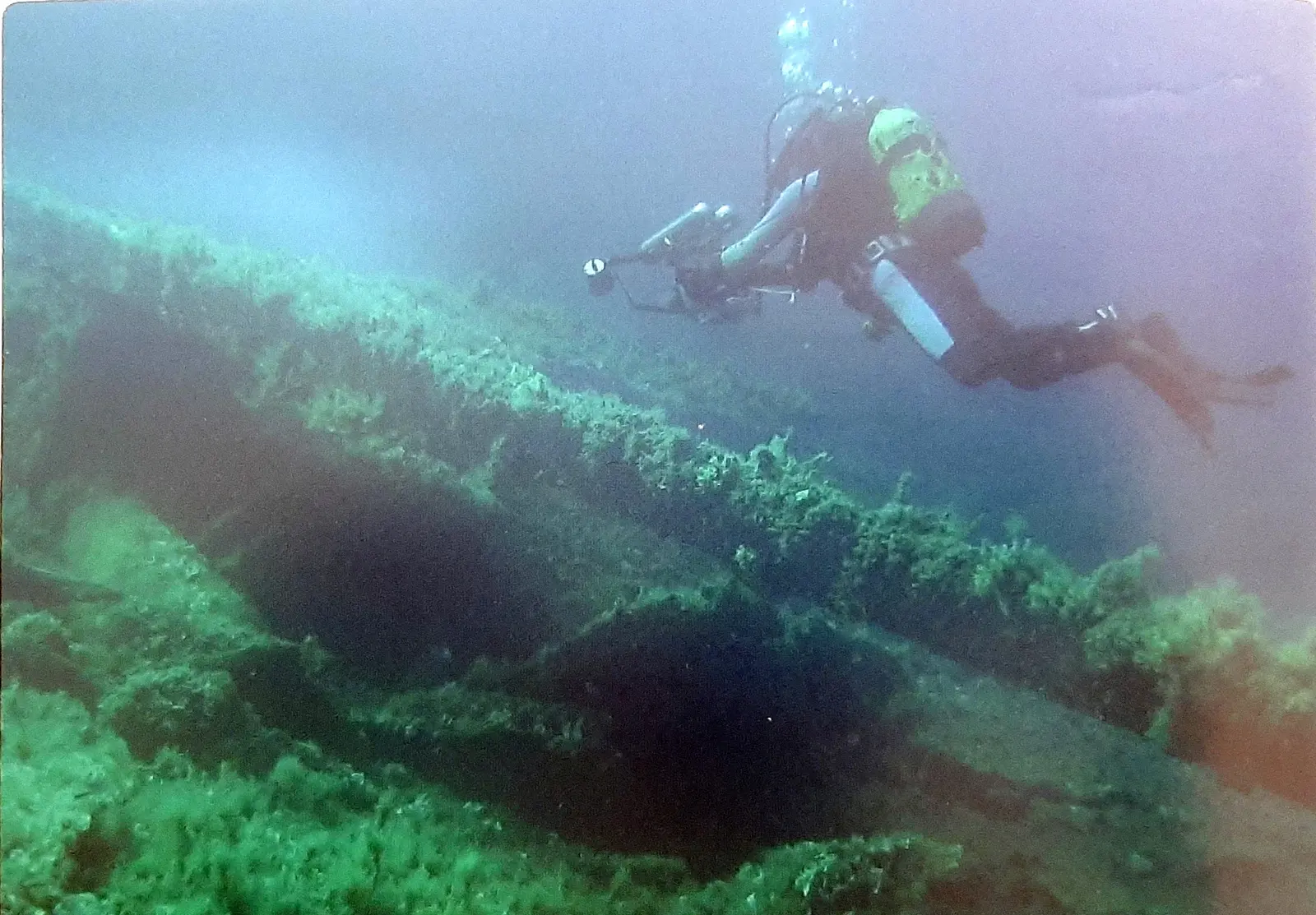
The remains of Srebreno are scattered around the Kalafat Reef rather than preserved as a complete, recognizable ship. Large sections of the hull have collapsed, while storms, currents and corrosion have displaced and fragmented smaller structural elements.
The site contains material from two very different vessels: a fast Austro-Hungarian naval destroyer built for torpedo warfare and a much larger commercial steamship designed to carry cargo over long distances. Their overlapping remains preserve evidence of different periods in Adriatic maritime history.
Careful archaeological documentation is needed to distinguish the construction features of the two wrecks. The dimensions and steelwork of Srebreno, together with surviving elements of its propulsion system, should differ considerably from those of the smaller Huszár, but decades of salvage and natural deterioration have complicated identification.
Diving Kalafat
The Kalafat site provides an opportunity to explore a complex underwater cultural landscape rather than a single intact wreck. Divers may encounter scattered hull plates, machinery and other metal components around the reef, but their relationship to either Srebreno or Huszár is not always immediately apparent.
The exposed position of the reef means that waves, currents and visibility can change rapidly. Sharp metal, unstable wreckage, fishing gear and surge around the rock create additional hazards. Visits should therefore be undertaken with qualified local guides and only in suitable weather and sea conditions.
Nothing should be removed, displaced or “collected.” Even an isolated fragment can help archaeologists reconstruct the location, orientation and breakup of the two vessels. Preserving objects in their archaeological context is essential to understanding the site.
Two ships, one landscape
Kalafat tells two interconnected stories. The remains of Huszár illustrate the naval development and strategic ambitions of Austria-Hungary before the First World War, while Srebreno represents Dubrovnik’s long-distance merchant fleet and Yugoslav commercial navigation on the eve of the Second World War.
The wrecks also demonstrate the continuing power of the maritime environment. Built for entirely different purposes and separated by more than three decades, both vessels were lost to the same hidden reef, severe weather and unsuccessful salvage operations.
With systematic research, photogrammetric recording and careful interpretation, the scattered remains can be presented as a single underwater cultural landscape—one that connects technology, navigation, commerce, naval history and the enduring hazards of Montenegro’s coast.
Crew: 35, all rescued
Present condition: Broken and scattered around the reef, overlapping with remains of SMS Huszár
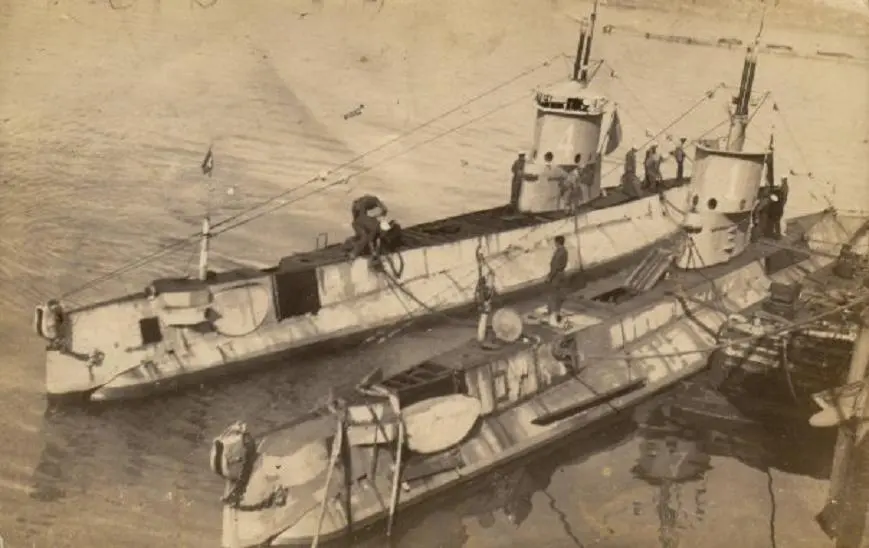 HMS H3Submarine · Near Mamula
 MongeSubmarine · Montenegrin coast
 Higgins 78Torpedo boat · Bay of Kotor
 Patrol Boat PBR-512Vessel · Žanjice Bay